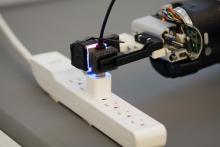
Researchers at MIT and Northeastern University have equipped a robot with a novel tactile sensor that lets it grasp a USB cable draped freely over a hook and insert it into a USB port.
Hacking is often done with malicious intent. But the two MIT alumni who co-founded fast-growing startup Tinfoil Security have shown that hacking can be put to good use: improving security.
Neuroscientists have found that a gene mutation that arose more than half a million years ago may be key to humans’ unique ability to produce and understand speech.
Deborah Halber | Picower Institute for Learning and Memory
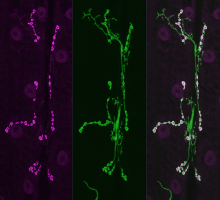
Patients with a rare neuromuscular disorder and those with nerve damage tied to autoimmune disorders may share the same faulty synapses, neuroscientists at MIT’s Picower Institute for Learning and Memory
Most memories have some kind of emotion associated with them: Recalling the week you just spent at the beach probably makes you feel happy, while reflecting on being bullied provokes more negative feelings.
Optogenetics, a technology that allows scientists to control brain activity by shining light on neurons, relies on light-sensitive proteins that can suppress or stimulate electrical signals within cells.
For the first time, MIT neuroscientists have shown they can control muscle movement by applying optogenetics — a technique that allows scientists to control neurons’ electrical impulses with light — to the spinal cords of