




MIT hosts American Junior Academy of Science delegates
by
Department of Biology
Image
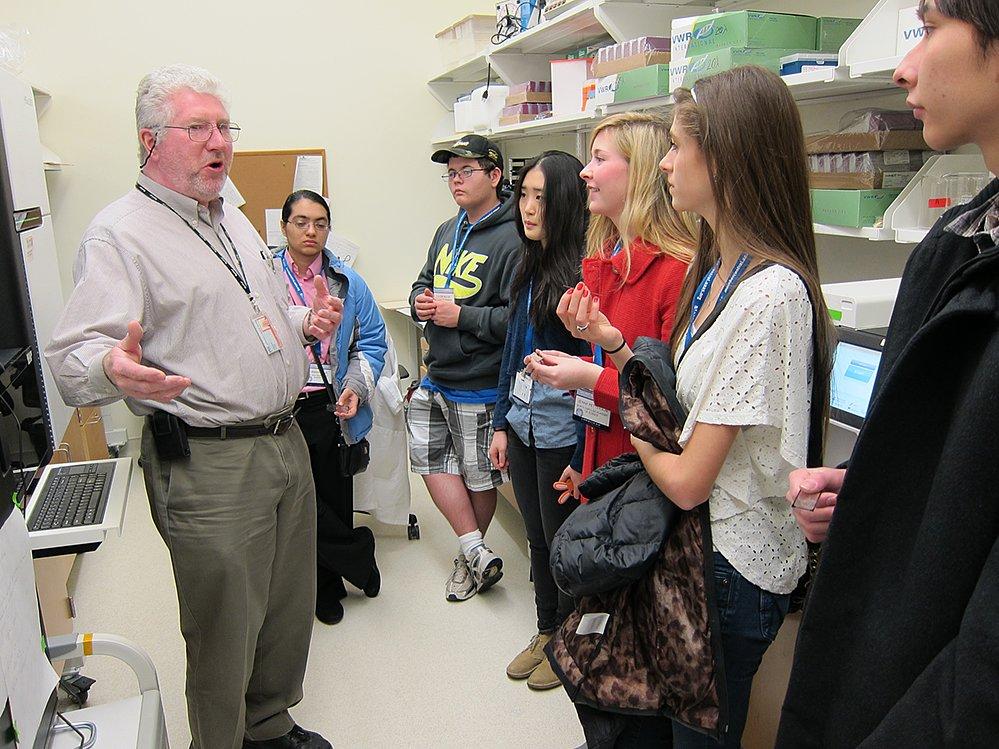
Richard Cook, a research scientist in the Koch Institute's Swanson Biotechnology Center, shows students around the Biopolymer and Proteomics Core Facility.
MIT hosted a full day of activities on Feb. 14 for 232 American Junior Academy of Science delegates — high school students, parents and teachers from across the nation — who were in Boston to attend the academy’s annual conference.
The day started with a well-received lecture on brain plasticity by Mriganka Sur, the Paul E. Newton Professor of Neuroscience at MIT. “It was absolutely fantastic to be given the opportunity to listen to a prominent professor talk about his work,” said Kanithra Sekaran, a high school student from Ohio who is now contemplating a career in neuroscience.
After the talk, the students visited research labs and met with MIT scientists, had lunch with graduate students at the Faculty Club, toured the campus and ended the day with a free visit to the MIT Museum. In total, 17 labs and more than 30 MIT scientists took part in the event.
Mandana Sassanfar, director of science outreach for the Biology and Brain and Cognitive Sciences departments, organized the day for the delegates. "Seeing such excitement and interest from these talented high schoolers is a wonderful reminder of how important it is for scientists to inspire and encourage young students to pursue a career in science and technology,” said Sassanfar, who is president of the National Association of Academies of Science, an affiliate of the American Association for the Advancement of Science (AAAS).
MIT Institute Professor Phillip Sharp, who is the new president of AAAS, praised the AJAS delegates during their visit. "The American Junior Academy of Science recognizes the remarkable achievements of young scientists in independent research," he said. “Their projects have been selected from across the nation as the most outstanding and we congratulate them.”
The high school students had positive things to say about MIT, as well.
“The best part about our tour day at MIT was seeing real scientists working in their labs on cutting edge research,” said Hale Miller of Ohio.
“They [the scientists] were so excited about their work, and so wiling to share everything they knew,” added Michelle Nemetchek, one of two students from Montana.
Some students reveled in the behind-the-scenes lab visits. “I’ve seen some images of fiber construction on TV shows, but being able to see first hand the process behind designing and developing these fibers was a very cool experience,” Jonathan Flynn, a senior from Braintree High School, said after visiting the Fink lab in the Research Laboratory of Electronics.
In that lab, postdoc Xiaoting Jia explained the making of microfibers for superconductors and demonstrated how preformed fibers were extended in the drawing tower located in the basement of Building 13. “It was very exciting for me to see so much curiosity from these high school students,” Jia said. “I really enjoyed the experience.”
MIT’s Media Lab was a favorite stop for California’s Léa Tran Le, who uses Scratch, children’s programming software designed in the lab. “I really enjoyed learning about CT scanning machines in the animal imaging facilities and seeing Eric Rosenbaum's research in helping kindergartners learn better through Scratch,” she said.
In fact, the Media Lab was a popular destination for a few others in the tour group, as well. “The Media Lab was amazing,” said Grace Griggs, a sophomore from Vermont. “It was like a scientist’s playground of crazy, creative inventions.”
“Meeting the creators of objects used in our everyday lives was quite inspirational,” added Hayden Allen, a senior from Oklahoma.
MIT students and staffers who exhibited their work for the tour said the students were certainly an inquisitive bunch. “They were very engaged and very interested to hear what kind of problems we were working on,” said Michael Funk, a fourth-year chemistry graduate student who works in the Drennan Research and Education Laboratory.
“A couple asked very insightful questions,” added Bob Grant, who showed students around the Structural Biology Core Facility, which he directs.
The event was co-sponsored by the schools of Science, Engineering, and Architecture and Planning, as well as the Biology and Brain and Cognitive Sciences departments.
The day started with a well-received lecture on brain plasticity by Mriganka Sur, the Paul E. Newton Professor of Neuroscience at MIT. “It was absolutely fantastic to be given the opportunity to listen to a prominent professor talk about his work,” said Kanithra Sekaran, a high school student from Ohio who is now contemplating a career in neuroscience.
After the talk, the students visited research labs and met with MIT scientists, had lunch with graduate students at the Faculty Club, toured the campus and ended the day with a free visit to the MIT Museum. In total, 17 labs and more than 30 MIT scientists took part in the event.
Mandana Sassanfar, director of science outreach for the Biology and Brain and Cognitive Sciences departments, organized the day for the delegates. "Seeing such excitement and interest from these talented high schoolers is a wonderful reminder of how important it is for scientists to inspire and encourage young students to pursue a career in science and technology,” said Sassanfar, who is president of the National Association of Academies of Science, an affiliate of the American Association for the Advancement of Science (AAAS).
MIT Institute Professor Phillip Sharp, who is the new president of AAAS, praised the AJAS delegates during their visit. "The American Junior Academy of Science recognizes the remarkable achievements of young scientists in independent research," he said. “Their projects have been selected from across the nation as the most outstanding and we congratulate them.”
The high school students had positive things to say about MIT, as well.
“The best part about our tour day at MIT was seeing real scientists working in their labs on cutting edge research,” said Hale Miller of Ohio.
“They [the scientists] were so excited about their work, and so wiling to share everything they knew,” added Michelle Nemetchek, one of two students from Montana.
Some students reveled in the behind-the-scenes lab visits. “I’ve seen some images of fiber construction on TV shows, but being able to see first hand the process behind designing and developing these fibers was a very cool experience,” Jonathan Flynn, a senior from Braintree High School, said after visiting the Fink lab in the Research Laboratory of Electronics.
In that lab, postdoc Xiaoting Jia explained the making of microfibers for superconductors and demonstrated how preformed fibers were extended in the drawing tower located in the basement of Building 13. “It was very exciting for me to see so much curiosity from these high school students,” Jia said. “I really enjoyed the experience.”
MIT’s Media Lab was a favorite stop for California’s Léa Tran Le, who uses Scratch, children’s programming software designed in the lab. “I really enjoyed learning about CT scanning machines in the animal imaging facilities and seeing Eric Rosenbaum's research in helping kindergartners learn better through Scratch,” she said.
In fact, the Media Lab was a popular destination for a few others in the tour group, as well. “The Media Lab was amazing,” said Grace Griggs, a sophomore from Vermont. “It was like a scientist’s playground of crazy, creative inventions.”
“Meeting the creators of objects used in our everyday lives was quite inspirational,” added Hayden Allen, a senior from Oklahoma.
MIT students and staffers who exhibited their work for the tour said the students were certainly an inquisitive bunch. “They were very engaged and very interested to hear what kind of problems we were working on,” said Michael Funk, a fourth-year chemistry graduate student who works in the Drennan Research and Education Laboratory.
“A couple asked very insightful questions,” added Bob Grant, who showed students around the Structural Biology Core Facility, which he directs.
The event was co-sponsored by the schools of Science, Engineering, and Architecture and Planning, as well as the Biology and Brain and Cognitive Sciences departments.