




Scholar spotlight: Ajani Stewart explores questions about hearing and the brain process
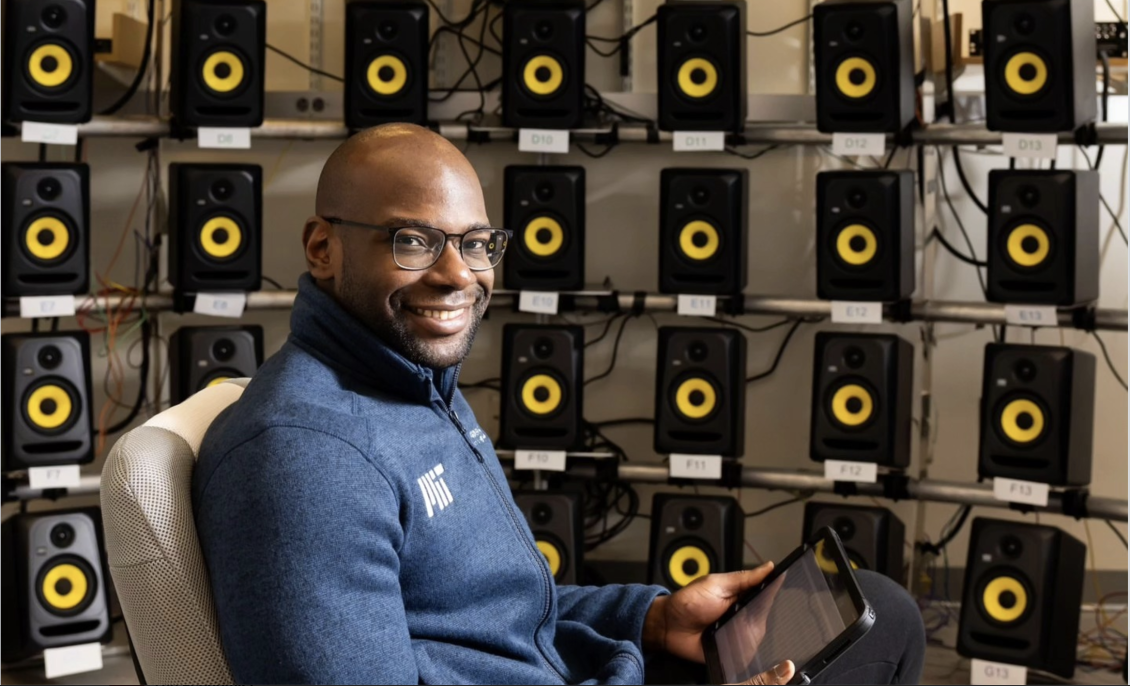
Name: Ajani Stewart
Year in program: 3rd
Advisor: Josh McDermott
What was the journey that brought you to BCS?
Growing up in Jamaica, I was always interested in science. Not any kind of science in particular, but I gravitated towards things like National Geographic and watching the Discovery Channel. In high school, I started to get interested in computer science and writing code, and when I was 17, I moved from Jamaica to New York City and started my undergrad at Hunter College as a computer science and math major.
I really enjoyed it, and I thought that I was probably going to become a software engineer. Then, in my sophomore year, I took an AI class. I was really intrigued, and I started doing some research with the professor who taught the class, Susan Epstein. That’s when I started thinking about a future in research, and she encouraged me to do the quantitative methods workshop here at MIT.
How did that workshop lead to where you are today?
That workshop was a pretty pivotal moment for me. I met a bunch of MIT faculty, including Jim DiCarlo. He told me about how his lab was using deep neural networks as models of the human visual system, how these networks are able to produce human-like behavior, and can predict brain activity.
I was so fascinated by this, and it really set me down a computational neuroscience route, but at this point, I've never even taken a neuroscience class. After the workshop, I applied and was accepted into the MSRP summer program, where I got to work in Jim’s lab. I learned a lot, and I felt that trying to answer some of the questions about the brain with my computer science skills would be worth my time and meaningful. I got an internship at Oak Ridge National Laboratory the next year, and then I was accepted into the BCS Research Scholars Postbac program, where I was placed in Josh McDermott’s lab.
I really enjoyed everything I was doing; it was really rewarding and made me more certain that this would be a good path for me. At the end of the program, I was accepted into BCS as a graduate student, and I am still in the McDermott lab today.
What do you like to do outside the lab?
I teach coding at MIT’s Quantitative Methods Workshop and demonstrate spatial-hearing illusions to middle-schoolers, and I mentor applicants from minority-serving institutions. I also enjoy listening and playing music, indoor bouldering, playing chess with my friends, and attempting to solve the New York Times crossword puzzles.
What are you working on now?
Right now, I am working on spatial hearing. How the brain determines where a sound is coming from when you hear it is not as simple as one might think. Unlike in vision, where you have a clearer topography where the brain and the visual cortex decide where things are, in audition, we figure out where sounds are coming from based on how loud one sound is when it hits one ear compared to the other, and the timing between when it hits one ear versus the other. It also depends on the folds of the ear. If you look at people's ears, they're all folded uniquely, and those folds filter the sound differently. Answering basic research questions about audition and the brain process could eventually lead to designs of cochlear implants or other kinds of implants to improve hearing.