

Main navigation

  • About BCS
    • Mission
    • History
    • Building 46
      • Building 46 Room Reservations
    • Leadership
    • Employment
    • Contact
      • BCS Spot Awards
      • Building 46 Email and Slack
    • Directory
  • Faculty + Research
    • Faculty
    • Areas of Research
    • Postdoctoral Research
      • Postdoctoral Association and Committees
    • Core Facilities
    • InBrain
      • InBRAIN Collaboration Data Sharing Policy
  • Academics
    • Course 9: Brain and Cognitive Sciences
    • Course 6-9: Computation and Cognition
      • Course 6-9 MEng
    • Brain and Cognitive Sciences PhD
      • How to Apply
      • Program Details
      • Classes
      • Research
      • Student Life
      • For Current Students
    • Molecular and Cellular Neuroscience Program
      • How to Apply to MCN
      • MCN Faculty and Research Areas
      • MCN Curriculum
      • Model Systems
      • MCN Events
      • MCN FAQ
      • MCN Contacts
    • Research Scholars Program
    • Course Offerings
  • News + Events
    • News
    • Events
    • Recordings
    • Newsletter
  • Community + Culture
    • Community + Culture
    • Community Stories
    • Outreach
      • MIT Summer Research Program (MSRP)
      • Conferences, Outreach and Networking Opportunities
    • Post-Baccalaureate Research Scholars Program
    • Get Involved (MIT login required)
    • Resources (MIT login Required)
  • Give to BCS
    • Join the Champions of the Brain Fellows Society
    • Meet Our Donors

Utility Menu

  • Directory
  • Apply to BCS
  • Contact Us

Footer

  • Contact Us
  • Employment
  • Be a Test Subject
  • Login

Footer 2

  • McGovern
  • Picower

Utility Menu

  • Directory
  • Apply to BCS
  • Contact Us
Brain and Cognitive Sciences
Menu
MIT

Main navigation

  • About BCS
    • Mission
    • History
    • Building 46
    • Leadership
    • Employment
    • Contact
    • Directory
  • Faculty + Research
    • Faculty
    • Areas of Research
    • Postdoctoral Research
    • Core Facilities
    • InBrain
  • Academics
    • Course 9: Brain and Cognitive Sciences
    • Course 6-9: Computation and Cognition
    • Brain and Cognitive Sciences PhD
    • Molecular and Cellular Neuroscience Program
    • Research Scholars Program
    • Course Offerings
  • News + Events
    • News
    • Events
    • Recordings
    • Newsletter
  • Community + Culture
    • Community + Culture
    • Community Stories
    • Outreach
    • Post-Baccalaureate Research Scholars Program
    • Get Involved (MIT login required)
    • Resources (MIT login Required)
  • Give to BCS
    • Join the Champions of the Brain Fellows Society
    • Meet Our Donors

News

News Menu

  • News
  • Events
  • Newsletters

Breadcrumb

  1. Home
  2. News
  3. Research highlights immune molecule’s complex role in Huntington’s disease
June 8, 2020

Research highlights immune molecule’s complex role in Huntington’s disease

by
David Orenstein | Picower Institute for Learning and Memory
Image
stat3-striatum-hyeseunglee.jpg
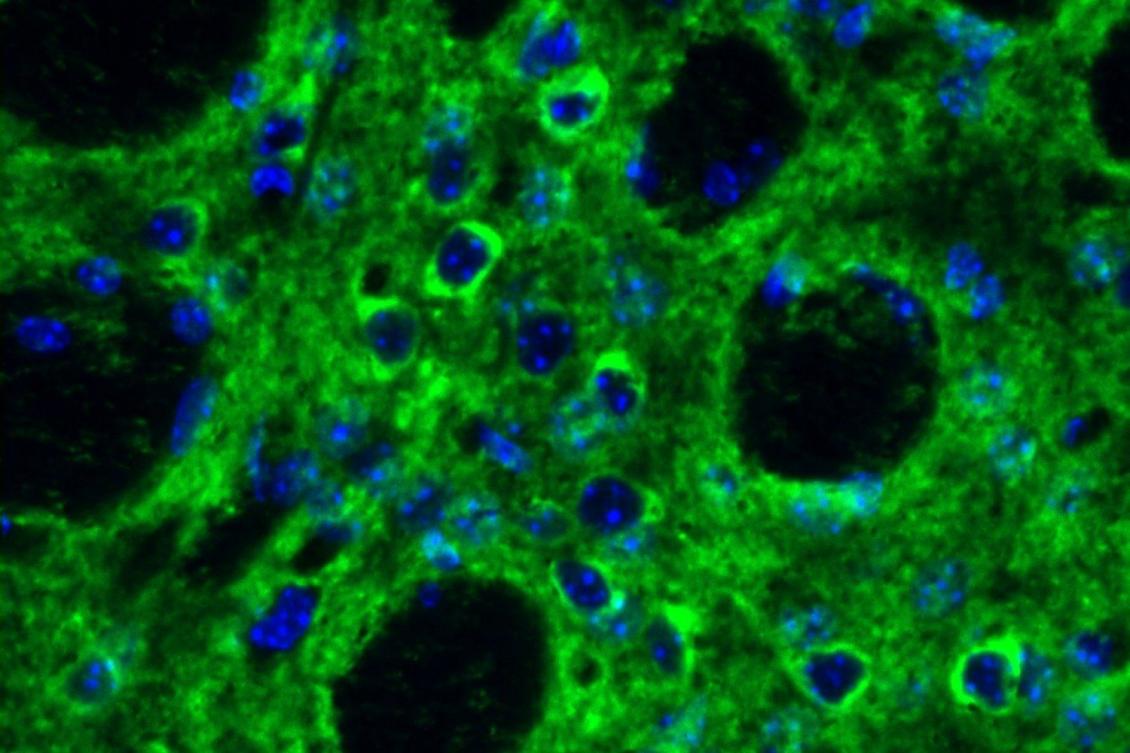
Researchers are studying the role of the immune system molecule IL-6 in Huntington's disease, which leads to neurodegeneration in a region of the brain called the striatum. In this figure from a prior study, green staining highlights Stat3 in the striatum. Stat3 is a major transducer of IL-6 signaling.

More than a decade before people with Huntington’s disease (HD) show symptoms, they can exhibit abnormally high levels of an immune-system molecule called interleukin-6 (IL-6), which has led many researchers to suspect IL-6 of promoting the eventual neurological devastation associated with the genetic condition. A new investigation by MIT neuroscientists shows that the story likely isn’t so simple. In a recent study they found that Huntington’s model mice bred to lack IL-6 showed exacerbated symptoms compared to HD mice that still had it.

“If one looks back in the literature of the Huntington’s disease field, many people have postulated that reductions to IL-6 would be therapeutic in HD,” says Myriam Heiman, associate professor in MIT’s Department of Brain and Cognitive Sciences and a member of The Picower Institute for Learning and Memory and the Broad Institute of MIT and Harvard. She is senior author of the paper in Molecular Neurodegeneration. Former postdoc Mary Wertz is the lead author.

To test the hypothesis that knocking out IL-6 would help HD mice, the researchers crossbred mice engineered to model HD with mice engineered to lack IL-6. They then compared the performance of offspring on a variety of standard movement tasks to that of healthy mice, mice just lacking IL-6, and mice just modeling HD but still having IL-6. The HD mice lacking IL-6 performed significantly worse than the other mouse lines, including the HD mice that still had IL-6.

The result was a surprise not only because of the record in prior studies, but also because in a paper published earlier this year, Wertz and Heiman conducted a sweeping analysis of genes that promoted neuron survival in Huntington’s disease and some of the hits they turned up were ones that are associated with interleukin signaling.

Struck by the findings in the new study, the team sought to understand why they occurred. To do that, they measured gene expression in all the major cell types in the striatum, the brain region most affected in HD, by sequencing RNA in thousands of individual cells in each mouse line. When they looked at the differences in gene expression in neurons between the two HD mouse lines — the ones that had IL-6 and the ones that didn’t — they saw that many genes important for synapses, the connections that link neurons into circuits, were significantly less expressed in the HD mice without IL-6.

“Perhaps this worsening of the phenotype is due to perturbation of those synaptic signaling pathways,” Heiman says.

While the study shows there is definitely not a therapeutic benefit to completely knocking out IL-6, it may still be possible to find a level between overexpression and complete knockout that is therapeutic, Heiman says. It may also be possible that timing is crucial. For instance, in this study mice lacked IL-6 right from birth, but potentially intervening to modulate IL-6 levels is more beneficial at some stage of adulthood, she says. The lab plans to continue to pursue that investigation.

“What these results show us is that we really have to understand which parts of innate immune signaling are activated when and what the order of events is,” she says.

In addition to Wertz and Heiman, the study’s other authors are S. Sebastian Pineda, Hyeseung Lee, Ruth Kulicke, and Manolis Kellis.

Funding for the research came from the JPB Foundation, the U.S. National Institutes of Health, the Bev Hartig Huntington’s Disease Foundation, the Brain Research Foundation, the Jeptha H. and Emily V. Wade Award, and the Hereditary Disease Foundation.

Read the Original Article
Don't miss our next newsletter!
Sign Up

Footer menu

  • Contact Us
  • Employment
  • Be a Test Subject
  • Login

Footer 2

  • McGovern
  • Picower
Brain and Cognitive Sciences

MIT Department of Brain and Cognitive Sciences

Massachusetts Institute of Technology

77 Massachusetts Avenue, Room 46-2005

Cambridge, MA 02139-4307 | (617) 253-5748

For Emergencies | Accessibility

Massachusetts Institute of Technology