

Main navigation

  • About BCS
    • Mission
    • History
    • Building 46
      • Building 46 Room Reservations
    • Leadership
    • Employment
    • Contact
      • BCS Spot Awards
      • Building 46 Email and Slack
    • Directory
  • Faculty + Research
    • Faculty
    • Areas of Research
    • Postdoctoral Research
      • Postdoctoral Association and Committees
    • Core Facilities
    • InBrain
      • InBRAIN Collaboration Data Sharing Policy
  • Academics
    • Course 9: Brain and Cognitive Sciences
    • Course 6-9: Computation and Cognition
      • Course 6-9 MEng
    • Brain and Cognitive Sciences PhD
      • How to Apply
      • Program Details
      • Classes
      • Research
      • Student Life
      • For Current Students
    • Molecular and Cellular Neuroscience Program
      • How to Apply to MCN
      • MCN Faculty and Research Areas
      • MCN Curriculum
      • Model Systems
      • MCN Events
      • MCN FAQ
      • MCN Contacts
    • Research Scholars Program
    • Course Offerings
  • News + Events
    • News
    • Events
    • Recordings
    • Newsletter
  • Community + Culture
    • Community + Culture
    • Community Stories
    • Outreach
      • MIT Summer Research Program (MSRP)
      • Conferences, Outreach and Networking Opportunities
    • Post-Baccalaureate Research Scholars Program
    • Get Involved (MIT login required)
    • Resources (MIT login Required)
  • Give to BCS
    • Join the Champions of the Brain Fellows Society
    • Meet Our Donors

Utility Menu

  • Directory
  • Apply to BCS
  • Contact Us

Footer

  • Contact Us
  • Employment
  • Be a Test Subject
  • Login

Footer 2

  • McGovern
  • Picower

Utility Menu

  • Directory
  • Apply to BCS
  • Contact Us
Brain and Cognitive Sciences
Menu
MIT

Main navigation

  • About BCS
    • Mission
    • History
    • Building 46
    • Leadership
    • Employment
    • Contact
    • Directory
  • Faculty + Research
    • Faculty
    • Areas of Research
    • Postdoctoral Research
    • Core Facilities
    • InBrain
  • Academics
    • Course 9: Brain and Cognitive Sciences
    • Course 6-9: Computation and Cognition
    • Brain and Cognitive Sciences PhD
    • Molecular and Cellular Neuroscience Program
    • Research Scholars Program
    • Course Offerings
  • News + Events
    • News
    • Events
    • Recordings
    • Newsletter
  • Community + Culture
    • Community + Culture
    • Community Stories
    • Outreach
    • Post-Baccalaureate Research Scholars Program
    • Get Involved (MIT login required)
    • Resources (MIT login Required)
  • Give to BCS
    • Join the Champions of the Brain Fellows Society
    • Meet Our Donors

News

News Menu

  • News
  • Events
  • Newsletters

Breadcrumb

  1. Home
  2. News
  3. Michale Fee receives McKnight Technological Innovations in Neuroscience Award
July 20, 2018

Michale Fee receives McKnight Technological Innovations in Neuroscience Award

by
Sabbi Lall | McGovern Institute for Brain Research
Image
michale-fee-mit-mcgovern-00.jpeg
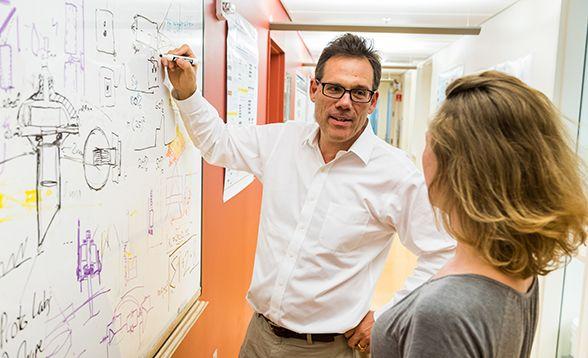
Michale Fee studies how the brain learns and generates complex sequential behaviors, with a focus on the songbird as a model system.

McGovern Institute investigator Michale Fee has been selected to receive a 2018 McKnight Technological Innovations in Neuroscience Award for his research on “new technologies for imaging and analyzing neural state-space trajectories in freely-behaving small animals.”

“I am delighted to get support from the McKnight Foundation,” says Fee, who is also the Glen V. and Phyllis F. Dorflinger Professor in the Department of Brain and Cognitive Neurosciences at MIT. “We’re very excited about this project which aims to develop technology that will be a great help to the broader neuroscience community.”

Fee studies the neural mechanisms by which the brain, specifically that of juvenile songbirds, learns complex sequential behaviors. The way that songbirds learn a song through trial and error is analogous to humans learning complex behaviors, such as riding a bicycle. While it would be insightful to link such learning to neural activity, current methods for monitoring neurons can only monitor a limited field of neurons, a big issue since such learning and behavior involve complex interactions between larger circuits. While a wider field of view for recordings would help decipher neural changes linked to this learning paradigm, current microscopy equipment is large relative to a juvenile songbird, and microscopes that can record neural activity generally constrain the behavior of small animals. Ideally, technologies need to be lightweight (about 1 gram) and compact in size (the size of a dime), a far cry from current larger microscopes that weigh in at 3 grams. Fee hopes to be able to break these technical boundaries and miniaturize the recording equipment thus allowing recording of more neurons in naturally behaving small animals.

“We are thrilled that the McKnight Foundation has chosen to support this project. The technology that Michale’s developing will help to better visualize and understand the circuits underlying learning,” says Robert Desimone, director of MIT’s McGovern Institute for Brain Research.

In addition to development and miniaturization of the microscopy hardware itself, the award will support the development of technology that helps analyze the resulting images, so that the neuroscience community at large can more easily deploy and use the technology.

Read the Original Article
Don't miss our next newsletter!
Sign Up

Footer menu

  • Contact Us
  • Employment
  • Be a Test Subject
  • Login

Footer 2

  • McGovern
  • Picower
Brain and Cognitive Sciences

MIT Department of Brain and Cognitive Sciences

Massachusetts Institute of Technology

77 Massachusetts Avenue, Room 46-2005

Cambridge, MA 02139-4307 | (617) 253-5748

For Emergencies | Accessibility

Massachusetts Institute of Technology