

Main navigation

  • About BCS
    • Mission
    • History
    • Building 46
      • Building 46 Room Reservations
    • Leadership
    • Employment
    • Contact
      • BCS Spot Awards
      • Building 46 Email and Slack
    • Directory
  • Faculty + Research
    • Faculty
    • Areas of Research
    • Postdoctoral Research
      • Postdoctoral Association and Committees
    • Core Facilities
    • InBrain
      • InBRAIN Collaboration Data Sharing Policy
  • Academics
    • Course 9: Brain and Cognitive Sciences
    • Course 6-9: Computation and Cognition
      • Course 6-9 MEng
    • Brain and Cognitive Sciences PhD
      • How to Apply
      • Program Details
      • Classes
      • Research
      • Student Life
      • For Current Students
    • Molecular and Cellular Neuroscience Program
      • How to Apply to MCN
      • MCN Faculty and Research Areas
      • MCN Curriculum
      • Model Systems
      • MCN Events
      • MCN FAQ
      • MCN Contacts
    • Research Scholars Program
    • Course Offerings
  • News + Events
    • News
    • Events
    • Recordings
    • Newsletter
  • Community + Culture
    • Community + Culture
    • Community Stories
    • Outreach
      • MIT Summer Research Program (MSRP)
      • Conferences, Outreach and Networking Opportunities
    • Post-Baccalaureate Research Scholars Program
    • Get Involved (MIT login required)
    • Resources (MIT login Required)
  • Give to BCS
    • Join the Champions of the Brain Fellows Society
    • Meet Our Donors

Utility Menu

  • Directory
  • Apply to BCS
  • Contact Us

Footer

  • Contact Us
  • Employment
  • Be a Test Subject
  • Login

Footer 2

  • McGovern
  • Picower

Utility Menu

  • Directory
  • Apply to BCS
  • Contact Us
Brain and Cognitive Sciences
Menu
MIT

Main navigation

  • About BCS
    • Mission
    • History
    • Building 46
    • Leadership
    • Employment
    • Contact
    • Directory
  • Faculty + Research
    • Faculty
    • Areas of Research
    • Postdoctoral Research
    • Core Facilities
    • InBrain
  • Academics
    • Course 9: Brain and Cognitive Sciences
    • Course 6-9: Computation and Cognition
    • Brain and Cognitive Sciences PhD
    • Molecular and Cellular Neuroscience Program
    • Research Scholars Program
    • Course Offerings
  • News + Events
    • News
    • Events
    • Recordings
    • Newsletter
  • Community + Culture
    • Community + Culture
    • Community Stories
    • Outreach
    • Post-Baccalaureate Research Scholars Program
    • Get Involved (MIT login required)
    • Resources (MIT login Required)
  • Give to BCS
    • Join the Champions of the Brain Fellows Society
    • Meet Our Donors

News

News Menu

  • News
  • Events
  • Newsletters

Breadcrumb

  1. Home
  2. News
  3. Kay Tye Receives the Society for Neuroscience Young Investigator Award
November 15, 2016

Kay Tye Receives the Society for Neuroscience Young Investigator Award

by
Joshua Sariñana | Picower Institute for Learning and Memory
Image
kay-tye-mit-award-2016_0.jpeg
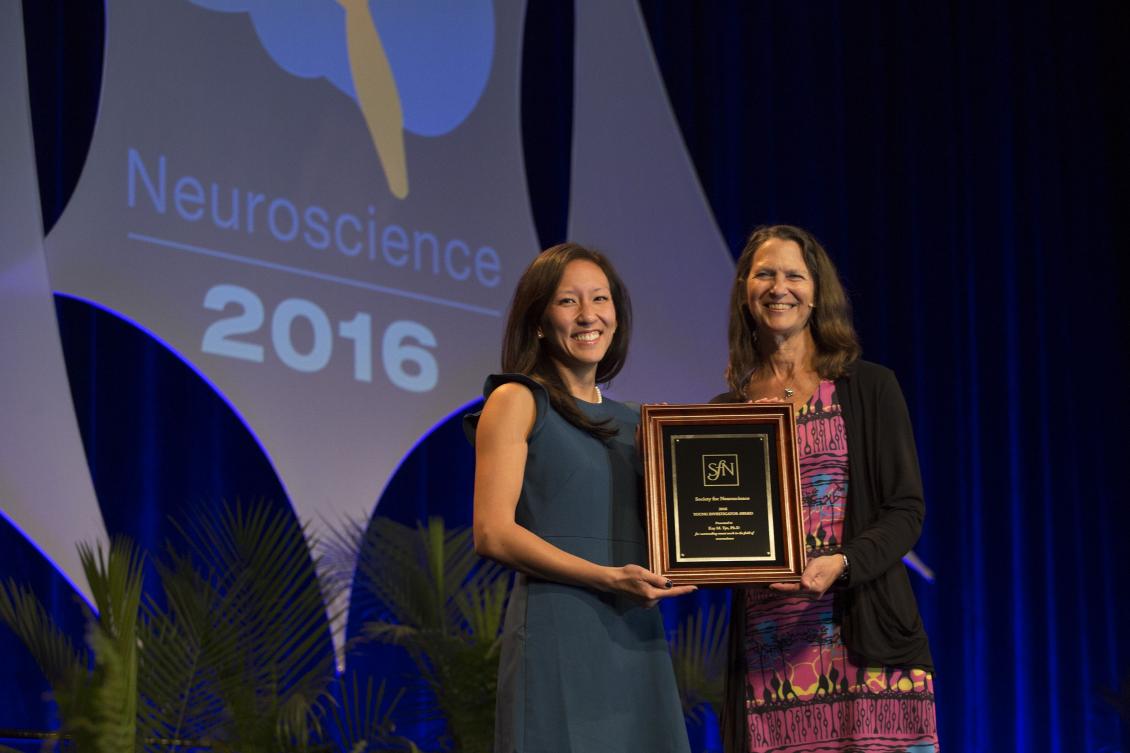
MIT Assistant Professor Kay Tye (left) receives the Young Investigator Award from Society for Neuroscience President Hollis Cline.

On Nov. 5, the Society for Neuroscience named Kay M. Tye the recipient of its Young Investigator Award, which recognizes outstanding achievements and contributions by a young neuroscientist. Tye, assistant professor of brain and cognitive sciences at MIT and a member of the Picower Institute for Learning and Memory, studies the neural circuitry and activity responsible for infusing experiences with either positive or negative emotions.

“She has profoundly changed the field of neuroscience both by initiating a new circuit-based approach to study how the brain works and by bringing to light an entirely new thinking on how the brain processes emotional value,” says Li-Huei Tsai, director of the Picower Institute for Learning and Memory. “Her vision is original, innovative, and transformative.”

Tye’s laboratory uses several advanced techniques to interrogate brain circuitry underlying emotions. More specifically, her group synthesizes electrophysiology, pharmacology, microscopy, behavioral training, and optogenetics to finely tease out the networks that specifically relate to positive and negative emotional states, also known as valence.

“Kay’s dedication to studying how emotional and motivational associations get assigned to environmental cues and in identifying the specific neuronal circuits that process this information and their divergence points to encode positive and negative valence, promises to provide important mechanistic insight into our understanding … [of] psychiatric disorders,” says James DiCarlo, head of the MIT Department of Brain and Cognitive Sciences.

The specific circuit that Tye studies includes (but is not limited to) the dopaminergic system and the amygdala. Although dopamine has historically been viewed as a neurotransmitter responsible for attributing positive valence to experiences, her lab has clearly shown that it is also important for negative valence. Conversely, her work shows that the amygdala — a region primarily studied in the storage and recall of negative experiences — plays a critical role in attributing positive valance to experiences.

“Understanding how the brain processes valence is fundamental to understanding the numerous disease states related to anxiety, depression, addiction, feeding, social interaction, and learning and memory” Tye says.

In directly relating neural circuitry to emotional processing Tye’s work threads multiple dimensions of neuroscience, from molecules to complex behavior, and overcomes some of the limitations of correlational work. “The Young Investigator Award is a huge honor because it includes all fields of neuroscience and I am very grateful for this recognition,” Tye says.

Read the Original Article
Don't miss our next newsletter!
Sign Up

Footer menu

  • Contact Us
  • Employment
  • Be a Test Subject
  • Login

Footer 2

  • McGovern
  • Picower
Brain and Cognitive Sciences

MIT Department of Brain and Cognitive Sciences

Massachusetts Institute of Technology

77 Massachusetts Avenue, Room 46-2005

Cambridge, MA 02139-4307 | (617) 253-5748

For Emergencies | Accessibility

Massachusetts Institute of Technology