




In her own words: BCS grad student Julia Leonard explores how our environment shapes learning
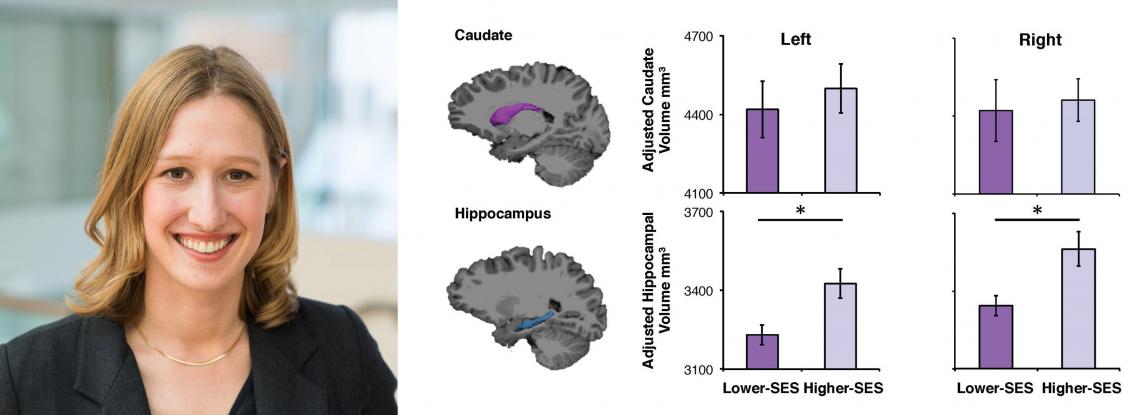
On left: Julia Leonard. On right: Figure 1: While hippocampal volume is significantly larger in higher-socioeconomic status (SES) adolescents compared to their lower-SES peers, caudate volume did not differ by SES group. All volumes are adjusted for sex. Error bars represent standard error; *p < 0.05 (from Leonard, J. A., Mackey, A. P., Finn, A. S., & Gabrieli, J. D. (2015). Differential effects of socioeconomic status on working and procedural memory systems. Frontiers in human neuroscience, 9).
When I was in college I noticed that many of my friends were taking “science for non-majors” classes. These classes were notorious for being easy and I couldn’t understand why these very bright people, who loved theorizing with me about evolution and space, had decided to settle for less challenging science classes. When I asked them, they responded with some version of “Oh, I’m not a science person.” This made me curious about why and when these theories of ourselves as learners start. What environmental experiences inform both how we conceptualize ourselves as learners (what we think we’re good at, where to put our efforts), and our capacity to learn (our memory and reasoning skills)?
 My first foray into this research area was as a research assistant in Dr. John Gabrieli’s lab in BCS where I worked on a project that explored how charter schools function as a form of academic intervention for low-income students. I was interested in working with this population because academic discouragement is especially true for low-income students and students of color, contributing to the widening income-achievement gap. While it has been well established that charter schools increase standardized test performance, we were interested in looking at what cognitive skills, besides test scores, charter schools might have an impact on. Families have to enter a lottery for admission to high-performing, over-subscribed charter schools in Boston. This gave us a perfect experimental design: we could compare the children who won the lottery and attended 3 years of charter school with those who did not and attended 3 years at a local public school. It turned out that while winning the lottery and attending a charter school did indeed improve children’s standardized test scores, it did not improve their basic cognitive abilities, like reasoning, memory, or processing speed. This was surprising to us because typically there’s a correlation between better test scores and better general cognition. Ongoing work in our lab is exploring how a selective enhancement of math and reading skills, without the expected co-enhancement of basic cognitive skills, will translate into long-term benefits for these students.
What most struck me about collecting data from hundreds of children from low-income backgrounds for this project was simply the fact that while some students were doing very well, both academically and on our cognitive tests, others floundered. I started to wonder what allows some children to be more immune to the adverse effects of growing up in financially unstable environments? In other words, what allows some people to be more resilient than others?
Around this time, I was accepted to MIT as a graduate student and began exploring these questions. Past work in the Gabrieli Lab and others has shown that growing up in poverty has negative impacts on brain structure and function. But little work had explored whether poverty specifically affects some neural structures and functions more than others. Perhaps the children I met who were doing so well were relying on these less affected mechanisms to succeed. It is well established that stress affects many aspects of development. For example, we know from work in rodents that stress has a profound negative impact on the hippocampus, a structure that supports declarative memory (your memory for facts or events), but not on the basal ganglia, which supports procedural memory (your implicit memory). We tested whether this was also true for children from low-income backgrounds, who are exposed to a high level of chronic stress. We found that while hippocampal structure and function are negatively affected by poverty, basal ganglia structure and function remain intact (Figure 1 above). Therefore, it could be the case that children who are most resilient in the face of poverty rely more on their basal ganglia than their less resilient peers. This hypothesis is something I’m further exploring in ongoing work.
While my work with Dr. Gabrieli explores school–aged children, we know that many formative aspects of cognitive development start in infancy. Thus, in my work with Dr. Laura Schulz, we try to understand how we learn about motivation and effort starting in the first year of life. It makes sense that we should learn how hard to try based on past experience, but what do you do when you encounter a novel situation? Perhaps the best thing to do would be to see how other people try. We tested this idea with babies, showing them that some toys either required a lot or a little effort to activate. Then we gave the babies a new toy and saw how hard they tried to activate it. Preliminary findings show that after babies saw an adult exert effort, they exerted more effort. In other words, infants seem sensitive to adult persistence and use it to calibrate their own tenacity. This research once again exemplifies the idea that we as humans are sensitive to our environment and shape our behaviors to best fit it.
While both genes and the environment shape development, I focus on studying how the environment impacts learning specifically because many aspects of it are modifiable. My hope is that we will use this research to create novel interventions that foster positive development in all children. And perhaps some of them will even be able eager to take on challenges, in the form of hard science classes or learning a new skill, in the future.
Photo: Leonard speaks at the fall 2016 Champions of the Brain Fellows celebration. Credit: Bryce Vickmark