




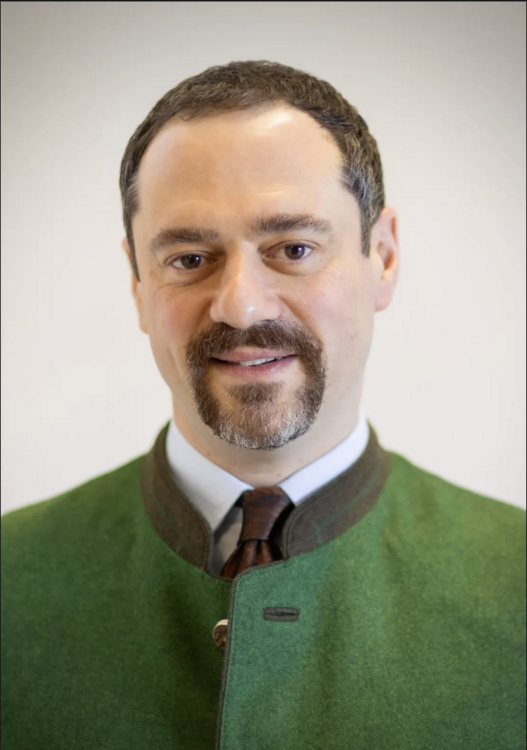
Colloquium on the Brain and Cognition with Roland Fleming
Description
Talk Title: Learning to See Stuff
Abstract: Every time we open our eyes, we gain access to a rich world of visual experiences. Without having to reach out and touch our surroundings, we can make detailed judgments about the physical properties of objects and materials. How does the brain achieve this, given the inherent ambiguity of raw sensory signals? I’ll present research from my lab on how we see, imagine, understand and interact with objects and materials. I’ll discuss how the visual system estimates material properties like glossiness and viscosity, and how we've been tapping into the underlying perceptual and neural computations. I’ll also suggest that material perception poses fundamental challenges for widely-held tenets of sensory neuroscience, like inverse optics. In addition to the 'perceptual inference' problem of estimating what's 'out there' for any given image, there's an even more fundamental 'ontological inference' challenge of working out what latent variables need to be estimated in the first place. I'll show how unsupervised learning helps the brain overcome this challenge, allowing us to predict both the broad successes of perception as well specific illusions.
Bio: Roland Fleming is the Kurt Koffka Professor of Experimental Psychology at Giessen University, Executive Director of the Center of Mind, Brain and Behavior and head of the Excellence Cluster "The Adaptive Mind". He studied at Oxford and MIT, and did a postdoc at the Max Planck Institute for Biological Cybernetics. He has been awarded the Vision Sciences Society Young Investigator Award as well as two ERC Grants (Consolidator and Advanced). In 2022 he was elected Fellow of the Royal Society of Biology.
Followed by a reception with food and drink in 3rd floor atrium