Main navigation

  • About BCS
    • Mission
    • History
    • Building 46
      • Building 46 Room Reservations
    • Leadership
    • Employment
    • Contact
      • BCS Spot Awards
      • Building 46 Email and Slack
    • Directory
  • Faculty + Research
    • Faculty
    • Areas of Research
    • Postdoctoral Research
      • Postdoctoral Association and Committees
    • Core Facilities
    • InBrain
      • InBRAIN Collaboration Data Sharing Policy
  • Academics
    • Course 9: Brain and Cognitive Sciences
    • Course 6-9: Computation and Cognition
      • Course 6-9 MEng
    • Brain and Cognitive Sciences PhD
      • How to Apply
      • Program Details
      • Classes
      • Research
      • Student Life
      • For Current Students
    • Molecular and Cellular Neuroscience Program
      • How to Apply to MCN
      • MCN Faculty and Research Areas
      • MCN Curriculum
      • Model Systems
      • MCN Events
      • MCN FAQ
      • MCN Contacts
    • Research Scholars Program
    • Course Offerings
  • News + Events
    • News
    • Events
    • Recordings
    • Newsletter
  • Community + Culture
    • Community + Culture
    • Community Stories
    • Outreach
      • MIT Summer Research Program (MSRP)
      • Conferences, Outreach and Networking Opportunities
    • Post-Baccalaureate Research Scholars Program
    • Get Involved (MIT login required)
    • Resources (MIT login Required)
  • Give to BCS
    • Join the Champions of the Brain Fellows Society
    • Meet Our Donors

Utility Menu

  • Directory
  • Apply to BCS
  • Contact Us

Footer

  • Contact Us
  • Employment
  • Be a Test Subject
  • Login

Footer 2

  • McGovern
  • Picower

Utility Menu

  • Directory
  • Apply to BCS
  • Contact Us
Brain and Cognitive Sciences
Menu
MIT

Main navigation

  • About BCS
    • Mission
    • History
    • Building 46
    • Leadership
    • Employment
    • Contact
    • Directory
  • Faculty + Research
    • Faculty
    • Areas of Research
    • Postdoctoral Research
    • Core Facilities
    • InBrain
  • Academics
    • Course 9: Brain and Cognitive Sciences
    • Course 6-9: Computation and Cognition
    • Brain and Cognitive Sciences PhD
    • Molecular and Cellular Neuroscience Program
    • Research Scholars Program
    • Course Offerings
  • News + Events
    • News
    • Events
    • Recordings
    • Newsletter
  • Community + Culture
    • Community + Culture
    • Community Stories
    • Outreach
    • Post-Baccalaureate Research Scholars Program
    • Get Involved (MIT login required)
    • Resources (MIT login Required)
  • Give to BCS
    • Join the Champions of the Brain Fellows Society
    • Meet Our Donors
Close shot of two researchers working in a wet lab

Understanding the brain. Comprehending the mind.

Featured News

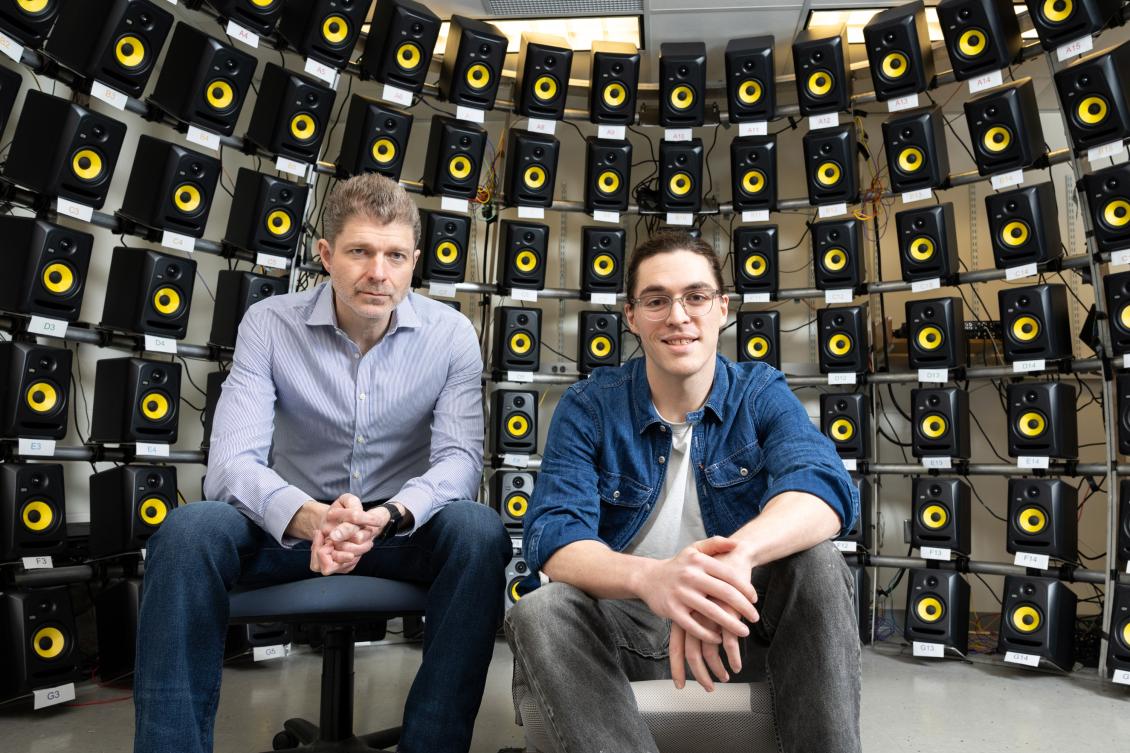
Josh McDermott (left), professor of brain and cognitive sciences and associate investigator at the McGovern Institute sits with graduate student Ian Griffith in the speaker array room where they conducted the study.
How the brain handles the “cocktail party problem”

MIT neuroscientists have figured out how the brain is able to focus on a single voice among a cacophony of many voices, shedding light on a longstanding neuroscientific phenomenon known as the cocktail party problem.

This attentional focus becomes necessary when you’re in any crowded environment, such as a cocktail party, with many conversations going on at once. Somehow, your brain is able to follow the voice of the person you’re talking to, despite all the other voices that you’re hearing in the background.

Using a computational model of the auditory system, the team found that amplifying the activity of the neural processing units that respond to features of a target voice, such as its pitch, allows that voice to be boosted to the forefront of attention.

“That simple motif is enough to cause much of the phenotype of human auditory attention to emerge, and the model ends up reproducing a very wide range of human attentional behaviors for sound,” says Josh McDermott, a professor of brain and cognitive sciences at MIT, a member of MIT’s McGovern Institute for Brain Research and Center for Brains, Minds, and Machines, and the senior author of the study.

More News

Featured News

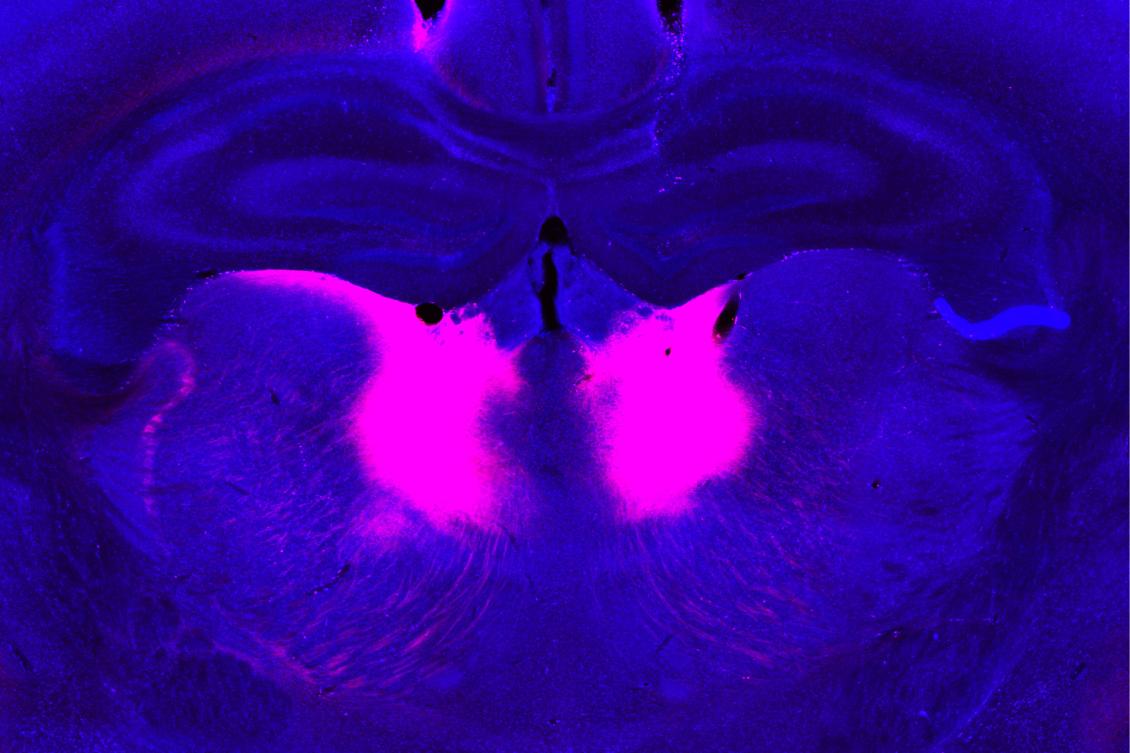
MIT researchers have identified neurons in the mediodorsal thalamus (labeled pink) whose dysfunction can lead to impairments in the ability to update beliefs based on new information.
Brain circuit needed to incorporate new information may be linked to schizophre…

One of the symptoms of schizophrenia is difficulty incorporating new information about the world. This can lead people with schizophrenia to struggle with making decisions and, eventually, to lose touch with reality.

MIT neuroscientists have now identified a gene mutation that appears to give rise to this type of difficulty. In a study of mice, the researchers found that the mutated gene impairs the function of a brain circuit that is responsible for updating beliefs based on new input.

This mutation, in a gene called grin2a, was originally identified in a large-scale screen of patients with schizophrenia. The new study suggests that drugs targeting this brain circuit could help with some of the cognitive impairments seen in people with schizophrenia.

“If this circuit doesn’t work well, you cannot quickly integrate information,” says Guoping Feng, the James W. and Patricia T. Poitras Professor in Brain and Cognitive Sciences at MIT, a member of the Broad Institute of Harvard and MIT, and the associate director of the McGovern Institute for Brain Research at MIT. “We are quite confident this circuit is one of the mechanisms that contributes to the cognitive impairment that is a major part of the pathology of schizophrenia.”

Feng and Michael Halassa, a professor of psychiatry and neuroscience and director of translational research at Tufts University School of Medicine, are the senior authors of the new study, which appeared in Nature Neuroscience. 

More News

Featured News

Illustration. A profile of a human head with a graphic of a brain inside, with green-blue glowing orbs.
To flexibly organize thought, the brain makes use of space

Our thoughts are specified by our knowledge and plans, yet our cognition can also be fast and flexible in handling new information. How does the well-controlled and yet highly nimble nature of cognition emerge from the brain’s anatomy of billions of neurons and circuits? A study by researchers in The Picower Institute for Learning and Memory at MIT provides new evidence that the answer might be found within a theory called “spatial computing.” 

First proposed in 2023 by Picower Professor Earl K. Miller and colleagues Mikael Lundqvist and Pawel Herman, spatial computing theory explains how neurons in the prefrontal cortex can be organized on the fly into a functional group capable of carrying out the information processing required by a cognitive task.

In the new study, lead author Zhen Chen and other current and former members of Miller’s lab put spatial computing to the test by examining whether five predictions it makes about neural activity and brain wave patterns were actually evident in measurements made in the prefrontal cortex of animals as they engaged in two working memory and one categorization tasks. Each prediction held true. 

More News
Don't miss our next newsletter!
Sign Up

Footer menu

  • Contact Us
  • Employment
  • Be a Test Subject
  • Login

Footer 2

  • McGovern
  • Picower
Brain and Cognitive Sciences

MIT Department of Brain and Cognitive Sciences

Massachusetts Institute of Technology

77 Massachusetts Avenue, Room 46-2005

Cambridge, MA 02139-4307 | (617) 253-5748

For Emergencies | Accessibility

Massachusetts Institute of Technology