




Why we say things the way we do
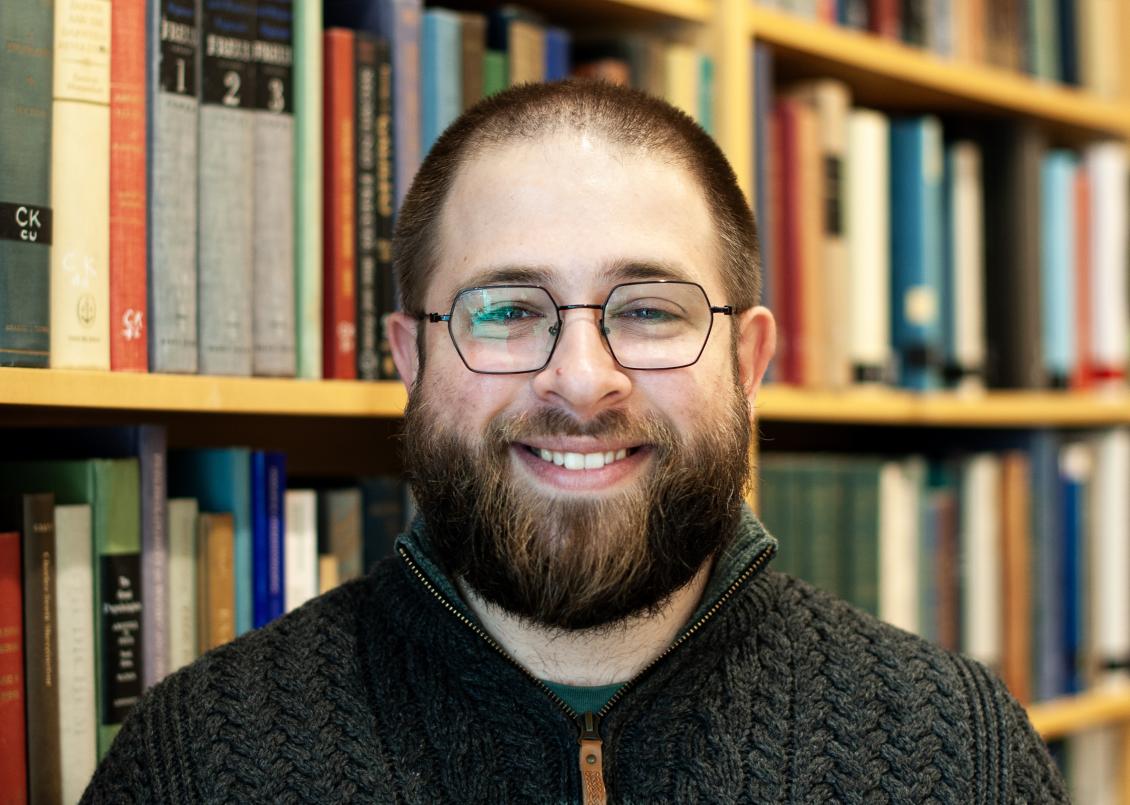
Moshe Poliak has always had a fascination with language. He grew up speaking Russian while learning Hebrew and English in school. But that wasn’t enough for him. As a teenager, he would take classes in Italian and Chinese, and travel an hour to a different city just to study Finnish.
That passion eventually led him to Harvard, where as an undergrad his interests in psychology and linguistics led him to an unexpected focus: psycholinguistics, the field that examines how the human mind produces and understands language.
“I never really saw myself as a scientist. I thought I would probably go through undergrad without ever taking a STEM course,” Poliak recalled. “Then my undergrad advisor, Professor Mahzarin Banaji, told me that if I wanted to do psychology seriously, I'd need the quantitative tools. She was right—and the methods I dreaded turned out to be the thing I love. Now I'm the one teaching statistics."”
Now a fourth-year PhD student in MIT’s Department of Brain and Cognitive Sciences in the lab of Professor Ted Gibson, Poliak studies one deceptively simple question: Why do we say things the way we do?
“The same idea can be expressed in infinitely many ways,” he says. “I’m interested in how people choose among those possibilities.”
Much of his research focuses on prosody—the music of speech. While in principle intonation patterns could be arbitrary, Poliak’s work suggests they carry important information.
In one line of research, he investigates how speakers naturally emphasize words that convey the most information, making them longer, louder, and higher in pitch. His work extends across more than a dozen languages, including English, Japanese, Finnish, Mandarin, Spanish, Turkish, Vietnamese, and Polish, in an effort to uncover communication principles that may be shared across cultures.
“The human mind is fundamentally the same across people,” Poliak says. "If a principle of communication is real, it should show up in every language we look at."
His research also explores how speakers choose between different grammatical constructions that express the same meaning and how those choices help listeners process information more efficiently. Together, these projects aim to reveal not just what people say, but how the way that they say it is optimized for human understanding.
Poliak sees these questions as more than theoretical. Autistic prosody, for example, is often described as 'atypical', yet the field has no precise way of saying what that means. Poliak is now applying his measures to speech from autistic speakers, replacing impressionistic labels with objective description: the necessary first step before anyone can improve communication. It could also help researchers develop AI systems that communicate in more natural, human-like ways.
Alongside his research, teaching has become one of Poliak’s greatest passions. He serves as a teaching assistant for Gibson’s course, 9.59: Lab in Psycholinguistics, where students design, run, and analyze their own experiments—often producing work that develops into publishable research. Watching students gain confidence and realize they can conduct meaningful science is among the most rewarding parts of his work.
“I’ve always thought of teaching as lighting one candle from another,” he says. “You don’t lose anything by sharing knowledge. Everyone becomes more knowledgeable.”
That philosophy reflects his broader view of academia. Rather than separating work from life, Poliak sees research and teaching as deeply fulfilling pursuits driven by curiosity and discovery. His long-term goal is to become a principal investigator, leading his own research group while mentoring the next generation of scientists.
Looking ahead, Poliak hopes to continue asking ambitious questions about language—whether through behavioral experiments, brain imaging, or computational models. He believes the biggest scientific advances come from pursuing questions that matter.
“Life is short,” he says. “I want to spend mine figuring out why we say things the way we do."