




Two studies reveal benefits of mindfulness for middle school students
Two new studies from MIT suggest that mindfulness — the practice of focusing one’s awareness on the present moment — can enhance academic performance and mental health in middle schoolers. The researchers found that more mindfulness correlates with better academic performance, fewer suspensions from school, and less stress.
“By definition, mindfulness is the ability to focus attention on the present moment, as opposed to being distracted by external things or internal thoughts. If you’re focused on the teacher in front of you, or the homework in front of you, that should be good for learning,” says John Gabrieli, the Grover M. Hermann Professor in Health Sciences and Technology, a professor of brain and cognitive sciences, and a member of MIT’s McGovern Institute for Brain Research.
The researchers also showed, for the first time, that mindfulness training can alter brain activity in students. Sixth-graders who received mindfulness training not only reported feeling less stressed, but their brain scans revealed reduced activation of the amygdala, a brain region that processes fear and other emotions, when they viewed images of fearful faces.
Together, the findings suggest that offering mindfulness training in schools could benefit many students, says Gabrieli, who is the senior author of both studies.
“We think there is a reasonable possibility that mindfulness training would be beneficial for children as part of the daily curriculum in their classroom,” he says. “What’s also appealing about mindfulness is that there are pretty well-established ways of teaching it.”
In the moment
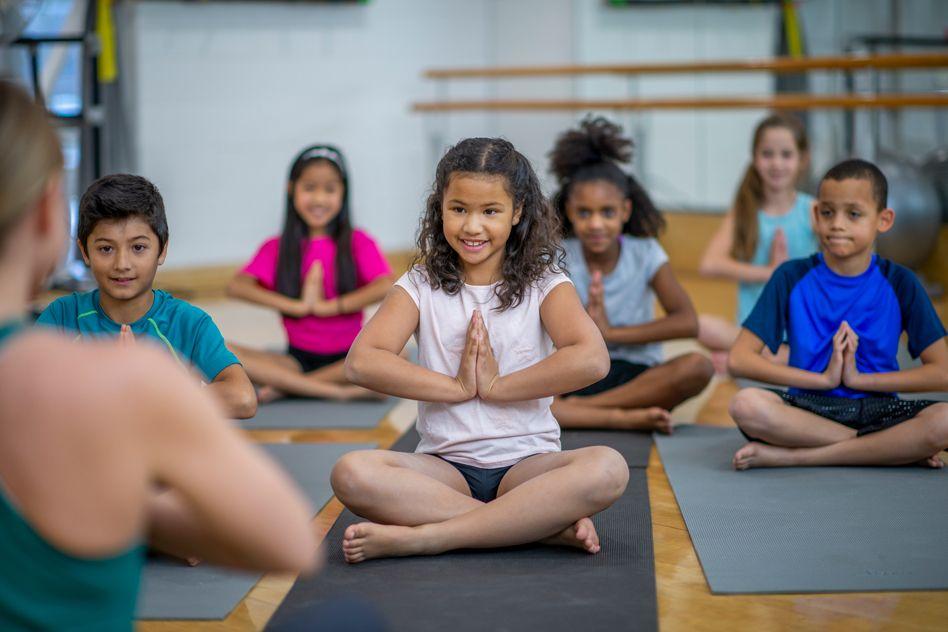
Both studies were performed at charter schools in Boston. In one of the papers, which appears today in the journal Behavioral Neuroscience, the MIT team studied about 100 sixth-graders. Half of the students received mindfulness training every day for eight weeks, while the other half took a coding class. The mindfulness exercises were designed to encourage students to pay attention to their breath, and to focus on the present moment rather than thoughts of the past or the future.
Students who received the mindfulness training reported that their stress levels went down after the training, while the students in the control group did not. Students in the mindfulness training group also reported fewer negative feelings, such as sadness or anger, after the training.
About 40 of the students also participated in brain imaging studies before and after the training. The researchers measured activity in the amygdala as the students looked at pictures of faces expressing different emotions.
At the beginning of the study, before any training, students who reported higher stress levels showed more amygdala activity when they saw fearful faces. This is consistent with previous research showing that the amygdala can be overactive in people who experience more stress, leading them to have stronger negative reactions to adverse events.
“There’s a lot of evidence that an overly strong amygdala response to negative things is associated with high stress in early childhood and risk for depression,” Gabrieli says.
After the mindfulness training, students showed a smaller amygdala response when they saw the fearful faces, consistent with their reports that they felt less stressed. This suggests that mindfulness training could potentially help prevent or mitigate mood disorders linked with higher stress levels, the researchers say.
Richard Davidson, a professor of psychology and psychiatry at the University of Wisconsin, says that the findings suggest there could be great benefit to implementing mindfulness training in middle schools.
“This is really one of the very first rigorous studies with children of that age to demonstrate behavioral and neural benefits of a simple mindfulness training,” says Davidson, who was not involved in the study.
Evaluating mindfulness
In the other paper, which appeared in the journal Mind, Brain, and Education in June, the researchers did not perform any mindfulness training but used a questionnaire to evaluate mindfulness in more than 2,000 students in grades 5-8. The questionnaire was based on the Mindfulness Attention Awareness Scale, which is often used in mindfulness studies on adults. Participants are asked to rate how strongly they agree with statements such as “I rush through activities without being really attentive to them.”
The researchers compared the questionnaire results with students’ grades, their scores on statewide standardized tests, their attendance rates, and the number of times they had been suspended from school. Students who showed more mindfulness tended to have better grades and test scores, as well as fewer absences and suspensions.
“People had not asked that question in any quantitative sense at all, as to whether a more mindful child is more likely to fare better in school,” Gabrieli says. “This is the first paper that says there is a relationship between the two.”
The researchers now plan to do a full school-year study, with a larger group of students across many schools, to examine the longer-term effects of mindfulness training. Shorter programs like the two-month training used in the Behavioral Neuroscience study would most likely not have a lasting impact, Gabrieli says.
“Mindfulness is like going to the gym. If you go for a month, that’s good, but if you stop going, the effects won’t last,” he says. “It’s a form of mental exercise that needs to be sustained.”
The research was funded by the Walton Family Foundation, the Poitras Center for Psychiatric Disorders Research at the McGovern Institute for Brain Research, and the National Council of Science and Technology of Mexico. Camila Caballero ’13, now a graduate student at Yale University, is the lead author of the Mind, Brain, and Education study. Caballero and MIT postdoc Clemens Bauer are lead authors of the Behavioral Neuroscience study. Additional collaborators were from the Harvard Graduate School of Education, Transforming Education, Boston Collegiate Charter School, and Calmer Choice.