




Researching from home: Science stays social, even at a distance
With all but a skeleton crew staying home from each lab to minimize the spread of Covid-19, scores of Picower Institute researchers are immersing themselves in the considerable amount of scientific work that can done away from the bench. With piles of data to analyze; plenty of manuscripts to write; new skills to acquire; and fresh ideas to conceive, share, and refine for the future, neuroscientists have full plates, even when they are away from their, well, plates. They are proving that science can remain social, even if socially distant.
Ever since the mandatory ramp down of on-campus research took hold March 20, for example, teams of researchers in the lab of Troy Littleton, the Menicon Professor of Neuroscience, have sharpened their focus on two data-analysis projects that are every bit as essential to their science as acquiring the data in the lab in the first place. Research scientist Yulia Akbergenova and graduate student Karen Cunningham, for example, are poring over a huge amount of imaging data showing how the strength of connections between neurons, or synapses, mature and how that depends on the molecular components at the site. Another team, comprised of Picower postdoc Suresh Jetti and graduate students Andres Crane and Nicole Aponte-Santiago, is analyzing another large dataset, this time of gene transcription, to learn what distinguishes two subclasses of motor neurons that form synapses of characteristically different strength.
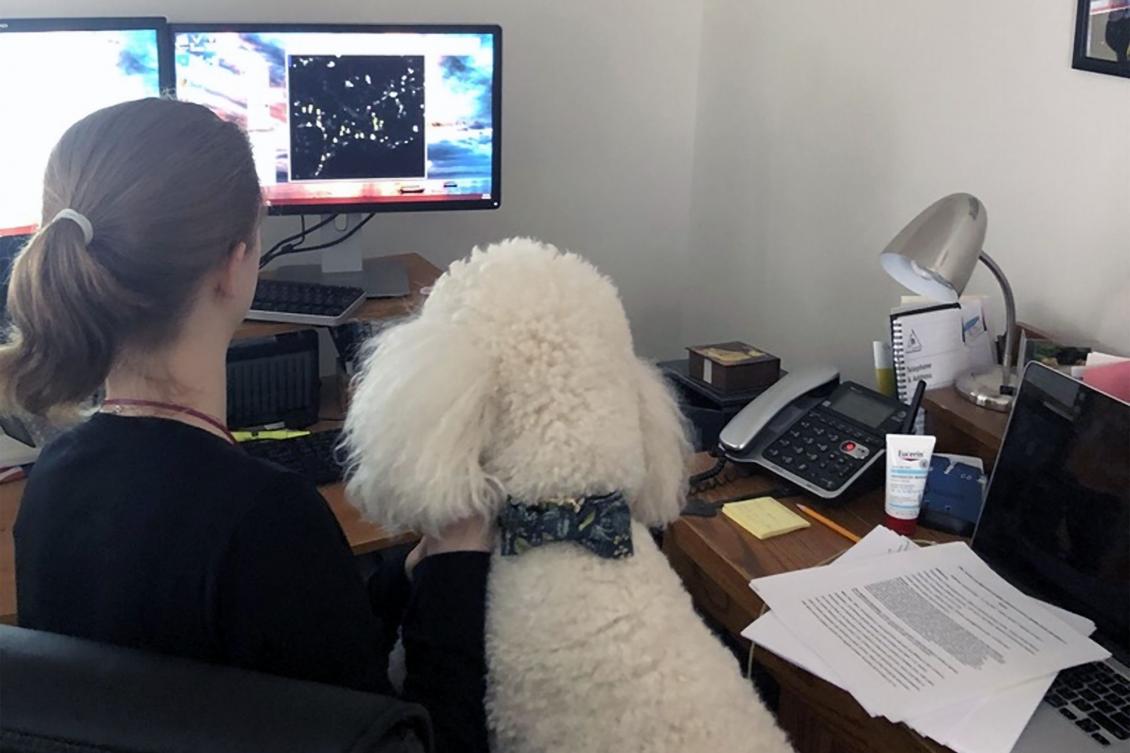
Work is similarly continuing among researchers in the lab of Elly Nedivi, the William R. (1964) and Linda R. Young Professor of Neuroscience. Since heading home, Senior Research Support Associate Kendyll Burnell has been looking at microscope images tracking how inhibitory interneurons innervate the visual cortex of mice throughout their development. By studying the maturation of inhibition, the lab hopes to improve understanding of the role of inhibitory circuitry in the experience-dependent changes, or plasticity, and development of the visual cortex, she says. As she’s worked, her poodle Soma (named for the central body structure of a neuron) has been by her side.
Despite extra time with comforts of home, though, it’s clear that nobody wanted this current mode of socially distant science. For every lab, it’s tremendously disruptive and costly. But labs are finding many ways to make progress nonetheless.
“Although we are certainly hurting because our lab work is at a standstill, the Miller lab is fortunate to have a large library of multiple-electrode neurophysiological data,” says Picower Professor Earl Miller. “The datasets are very rich. As our hypotheses and analytical tools develop, we can keep going back to old data to ask new questions. We are taking advantage of the wet lab downtime to analyze data and write papers. We have three under review and are writing at least three more right now.”
Miller is inviting new collaborations regardless of the physical impediment of social distancing. A recent lab meeting held via the videoconferencing app Zoom included MIT Department of Brain and Cognitive Sciences Associate Professor Ila Fiete and her graduate student, Mikail Khona. The Miller lab has begun studying how neural rhythms move around the cortex and what that means for brain function. Khona presented models of how timing relationships affect those waves. While this kind of an interaction between labs of the Picower Institute and the McGovern Institute for Brain Research would normally have taken place in person in MIT’s Building 46, neither lab let the pandemic get in the way.
Similarly, the lab of Li-Huei Tsai, Picower Professor and director of the Picower Institute, has teamed up with that of Manolis Kellis, professor in the MIT Computer Science and Artificial Intelligence Laboratory. They’re forming several small squads of experimenters and computational experts to launch analyses of gene expression and other data to illuminate the fate of individual cell types like interneurons or microglia in the context of the Alzheimer’s disease-afflicted brain. Other teams are focusing on analyses of questions such as how pathology varies in brain samples carrying different degrees of genetic risk factors. These analyses will prove useful for stages all along the scientific process, Tsai says, from forming new hypotheses to wrapping up papers that are well underway.
Remote collaboration and communication are proving crucial to researchers in other ways, too, proving that online interactions, though distant, can be quite personally fulfilling.
Nicholas DiNapoli, a research engineer in the lab of Associate Professor Kwanghun Chung, is making the best of time away from the bench by learning about the lab’s computational pipeline for processing the enormous amounts of imaging data it generates. He’s also taking advantage of a new program within the lab in which Senior Computer Scientist Lee Kamentsky is teaching Python computer programming principles to anyone in the lab who wants to learn. The training occurs via Zoom two days a week.
As part of a crowded calendar of Zoom meetings, or “Zeetings” as the lab has begun to call them, Newton Professor Mriganka Sur says he makes sure to have one-to-one meetings with everyone in the lab. The team also has organized into small subgroups around different themes of the lab’s research.
But also, the lab has continued to maintain its cohesion by banding together informally creating novel work and social experiences.
Graduate student Ning Leow, for example, used Zoom to create a co-working session in which participants kept a video connection open for hours at a time, just to be in each other’s virtual presence while they worked. Among a group of Sur lab friends, she read a paper related to her thesis and did a substantial amount of data analysis. She also advised a colleague on an analysis technique via the connection.
“I’ve got to say that it worked out really well for me personally because I managed to get whatever I wanted to complete on my list done,” she says, “and there was also a sense of healthy accountability along with the sense of community.”
Whether in person or via an officially imposed distance, science is social. In that spirit, graduate student K. Guadalupe "Lupe" Cruz organized a collaborative art event via Zoom for female scientists in brain and cognitive sciences at MIT. She took a photo of Rosalind Franklin, the scientist whose work was essential for resolving the structure of DNA, and divided it into nine squares to distribute to the event attendees. Without knowing the full picture, everyone drew just their section, talking all the while about how the strange circumstances of Covid-19 have changed their lives. At the end, they stitched their squares together to reconstruct the image.
Examples abound of how Picower scientists, though mostly separate and apart, are still coming together to advance their research and to maintain the fabric of their shared experiences.