

Main navigation

  • About BCS
    • Mission
    • History
    • Building 46
      • Building 46 Room Reservations
    • Leadership
    • Employment
    • Contact
      • BCS Spot Awards
      • Building 46 Email and Slack
    • Directory
  • Faculty + Research
    • Faculty
    • Areas of Research
    • Postdoctoral Research
      • Postdoctoral Association and Committees
    • Core Facilities
    • InBrain
      • InBRAIN Collaboration Data Sharing Policy
  • Academics
    • Course 9: Brain and Cognitive Sciences
    • Course 6-9: Computation and Cognition
      • Course 6-9 MEng
    • Brain and Cognitive Sciences PhD
      • How to Apply
      • Program Details
      • Classes
      • Research
      • Student Life
      • For Current Students
    • Molecular and Cellular Neuroscience Program
      • How to Apply to MCN
      • MCN Faculty and Research Areas
      • MCN Curriculum
      • Model Systems
      • MCN Events
      • MCN FAQ
      • MCN Contacts
    • Research Scholars Program
    • Course Offerings
  • News + Events
    • News
    • Events
    • Recordings
    • Newsletter
  • Community + Culture
    • Community + Culture
    • Community Stories
    • Outreach
      • MIT Summer Research Program (MSRP)
      • Conferences, Outreach and Networking Opportunities
    • Post-Baccalaureate Research Scholars Program
    • Get Involved (MIT login required)
    • Resources (MIT login Required)
  • Give to BCS
    • Join the Champions of the Brain Fellows Society
    • Meet Our Donors

Utility Menu

  • Directory
  • Apply to BCS
  • Contact Us

Footer

  • Contact Us
  • Employment
  • Be a Test Subject
  • Login

Footer 2

  • McGovern
  • Picower

Utility Menu

  • Directory
  • Apply to BCS
  • Contact Us
Brain and Cognitive Sciences
Menu
MIT

Main navigation

  • About BCS
    • Mission
    • History
    • Building 46
    • Leadership
    • Employment
    • Contact
    • Directory
  • Faculty + Research
    • Faculty
    • Areas of Research
    • Postdoctoral Research
    • Core Facilities
    • InBrain
  • Academics
    • Course 9: Brain and Cognitive Sciences
    • Course 6-9: Computation and Cognition
    • Brain and Cognitive Sciences PhD
    • Molecular and Cellular Neuroscience Program
    • Research Scholars Program
    • Course Offerings
  • News + Events
    • News
    • Events
    • Recordings
    • Newsletter
  • Community + Culture
    • Community + Culture
    • Community Stories
    • Outreach
    • Post-Baccalaureate Research Scholars Program
    • Get Involved (MIT login required)
    • Resources (MIT login Required)
  • Give to BCS
    • Join the Champions of the Brain Fellows Society
    • Meet Our Donors

News

News Menu

  • News
  • Events
  • Newsletters

Breadcrumb

  1. Home
  2. News
  3. Neural implants modulate microstructures in the brain with pinpoint accuracy
June 28, 2018

Neural implants modulate microstructures in the brain with pinpoint accuracy

by
Windy Pham | Institute for Medical Engineering and Science
Image
modulating-microstructures-in-brain-mit-00_0.png
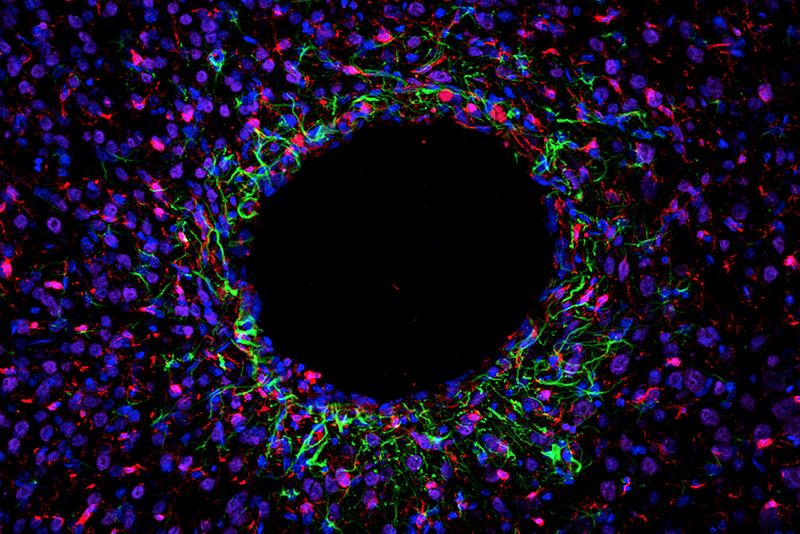
MiNDS probes developed at MIT cause minimal injury to brain tissue. This image shows minimal tissue scarring (green and red stains) and healthy neuron growth (purple) surrounding an implant.

The diversity of structures and functions of the brain is becoming increasingly realized in research today. Key structures exist in the brain that regulate emotion, anxiety, happiness, memory, and mobility. These structures can come in a huge variety of shapes and sizes and can all be physically near one another. Dysfunction of these structures and circuits linking them are common causes of many neurologic and neuropsychiatric diseases. For example, the substantia nigra is only a few millimeters in size yet is crucial for movement and coordination. Destruction of substantia nigra neurons is what causes motor symptoms in Parkinson’s disease.

New technologies such as optogenetics have allowed us to identify similar microstructures in the brain. However, these techniques rely on liquid infusions into the brain, which prepare the regions to be studied to respond to light. These infusions are done with large needles, which do not have the fine control to target specific regions. Clinical therapy has also lagged behind. New drug therapies aimed at treating these conditions are delivered orally, which results in drug distribution throughout the brain, or through large needle-cannulas, which do not have the fine control to accurately dose specific regions. As a result, patients of neurologic and psychiatric disorders frequently fail to respond to therapies due to poor drug delivery to diseased regions.

A new study addressing this problem has been published in Proceedings of the National Academy of Sciences. The lead author is Khalil Ramadi, a medical engineering and medical physics (MEMP) PhD candidate in the Harvard-MIT Program in Health Sciences and Technology (HST). For this study, Khalil and his thesis advisor, Michael Cima, the David H. Koch Professor of Engineering within the Department of Materials Science and Engineering and the Koch Institute for Integrative Cancer Research, and associate dean of innovation in the School of Engineering, collaborated with Institute Professors Robert Langer and Ann Graybiel to tackle this issue.

The team developed tools to enable targeted delivery of nanoliters of drugs to deep brain structures through chronically implanted microprobes. They also developed nuclear imaging techniques using positron emission tomography (PET) to measure the volume of the brain region targeted with each infusion. “Drugs for disorders of the central nervous system are nonspecific and get distributed throughout the brain,” Cima says. “Our animal studies show that volume is a critical factor when delivering drugs to the brain, as important as the total dose delivered. Using microcannulas and microPET imaging, we can control the area of brain exposed to these drugs, improving targeting accuracy double time comparing to the traditional methods used today.”

The researchers were also able to design cannulas that are MRI-compatible and implanted up to one year in rats. Implanting these cannulas with micropumps allowed the researchers to remotely control the behavior of animals. Significantly, they found that varying the volume infused alone had a profound effect on behavior induced, even if the total drug dose delivered stayed constant. These results show that regulation of volume delivery to brain region is extremely important in influencing brain activity. This technology could potentially enable precise investigation of neurological disease pathology in preclinical models, and more effective treatment in human patients.

Read the Original Article
Don't miss our next newsletter!
Sign Up

Footer menu

  • Contact Us
  • Employment
  • Be a Test Subject
  • Login

Footer 2

  • McGovern
  • Picower
Brain and Cognitive Sciences

MIT Department of Brain and Cognitive Sciences

Massachusetts Institute of Technology

77 Massachusetts Avenue, Room 46-2005

Cambridge, MA 02139-4307 | (617) 253-5748

For Emergencies | Accessibility

Massachusetts Institute of Technology