




MIT-Takeda program launches
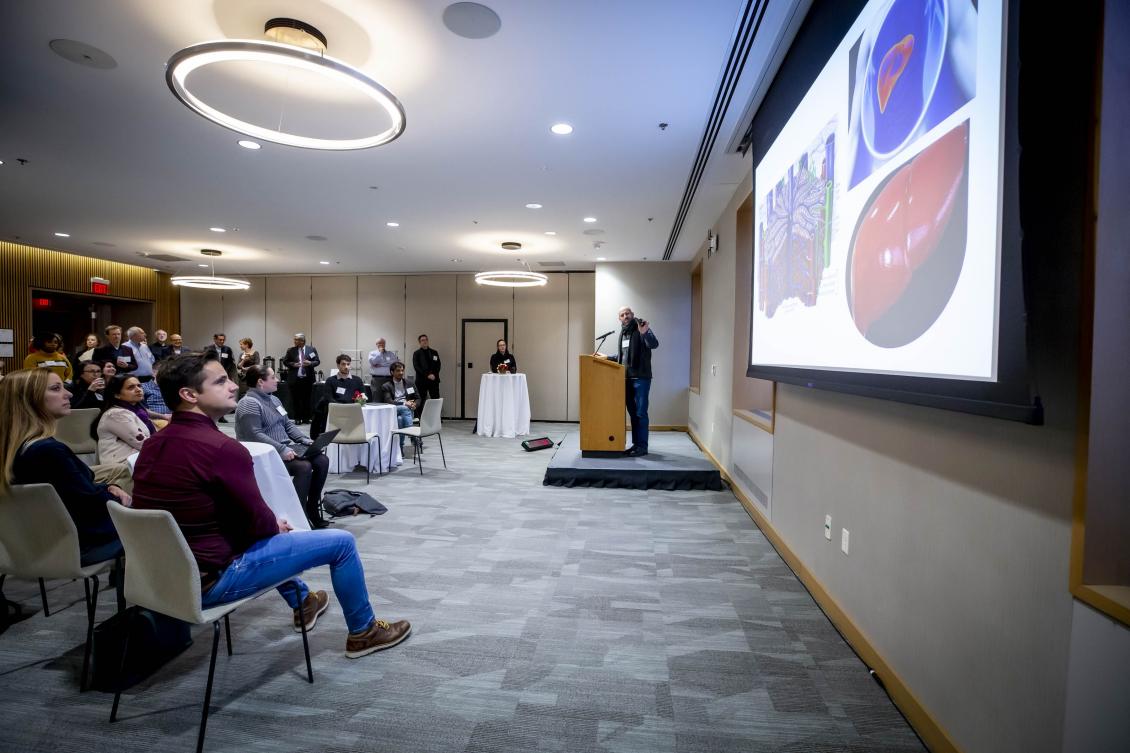
In February, researchers from MIT and Takeda Pharmaceuticals joined together to celebrate the official launch of the MIT-Takeda Program. The MIT-Takeda Program aims to fuel the development and application of artificial intelligence (AI) capabilities to benefit human health and drug development. Centered within the Abdul Latif Jameel Clinic for Machine Learning in Health (J-Clinic), the program brings together the MIT School of Engineering and Takeda Pharmaceuticals, to combine knowledge and address challenges of mutual interest.
Following a competitive proposal process, nine inaugural research projects were selected. The program’s flagship research projects include principal investigators from departments and labs spanning the School of Engineering and the Institute. Research includes diagnosis of diseases, prediction of treatment response, development of novel biomarkers, process control and improvement, drug discovery, and clinical trial optimization.
“We were truly impressed by the creativity and breadth of the proposals we received,” says Anantha P. Chandrakasan, dean of the School of Engineering, Vannevar Bush Professor of Electrical Engineering and Computer Science, and co-chair of the MIT-Takeda Program Steering Committee.
Engaging with researchers and industry experts from Takeda, each project team will bring together different disciplines, merging theory and practical implementation, while combining algorithm and platform innovations.
“This is an incredible opportunity to merge the cross-disciplinary and cross-functional expertise of both MIT and Takeda researchers,” says Chandrakasan. “This particular collaboration between academia and industry is of great significance as our world faces enormous challenges pertaining to human health. I look forward to witnessing the evolution of the program and the impact its research aims to have on our society.”
“The shared enthusiasm and combined efforts of researchers from across MIT and Takeda have the opportunity to shape the future of health care,” says Anne Heatherington, senior vice president and head of Data Sciences Institute (DSI) at Takeda, and co-chair of the MIT-Takeda Program Steering Committee. “Together we are building capabilities and addressing challenges through interrogation of multiple data types that we have not been able to solve with the power of humans alone that have the potential to benefit both patients and the greater community.”
The following are the inaugural projects of the MIT-Takeda Program. Included are the MIT teams collaborating with Takeda researchers, who are leveraging AI to positively impact human health.
"AI-enabled, automated inspection of lyophilized products in sterile pharmaceutical manufacturing": Duane Boning, the Clarence J. LeBel Professor of Electrical Engineering and faculty co-director of the Leaders for Global Operations program; Luca Daniel, professor of electrical engineering and computer science; Sanjay Sarma, the Fred Fort Flowers and Daniel Fort Flowers Professor of Mechanical Engineering and director of digital learning; and Brian Subirana, research scientist and director MIT Auto-ID Laboratory within the Department of Mechanical Engineering.
"Automating adverse effect assessments and scientific literature review": Regina Barzilay, the Delta Electronics Professor of Electrical Engineering and Computer Science and J-Clinic faculty co-lead; Tommi Jaakkola, the Thomas Siebel Professor of Electrical Engineering and Computer Science and the Institute for Data, Systems, and Society; and Jacob Andreas, assistant professor of electrical engineering and computer science.
"Automated analysis of speech and language deficits for frontotemporal dementia": James Glass, senior research scientist in the MIT Computer Science and Artificial Intelligence Laboratory; Sanjay Sarma, the Fred Fort Flowers and Daniel Fort Flowers Professor of Mechanical Engineering and director of digital learning; and Brian Subirana, research scientist and director of the MIT Auto-ID Laboratory within the Department of Mechanical Engineering.
"Discovering human-microbiome protein interactions with continuous distributed representation": Jim Collins, the Termeer Professor of Medical Engineering and Science in MIT’s Institute for Medical Engineering and Science and Department of Biological Engineering, Jameel Clinic faculty co-lead, and MIT-Takeda Program faculty lead; and Timothy Lu, associate professor of electrical engineering and computer science and of biological engineering.
"Machine learning for early diagnosis, progression risk estimation, and identification of non-responders to conventional therapy for inflammatory bowel disease": Peter Szolovits, professor of computer science and engineering, and David Sontag, associate professor of electrical engineering and computer science.
"Machine learning for image-based liver phenotyping and drug discovery": Polina Golland, professor of electrical engineering and computer science; Brian W. Anthony, principal research scientist in the Department of Mechanical Engineering; and Peter Szolovits, professor of computer science and engineering.
"Predictive in silico models for cell culture process development for biologics manufacturing": Connor W. Coley, assistant professor of chemical engineering, and J. Christopher Love, the Raymond A. (1921) and Helen E. St. Laurent Professor of Chemical Engineering.
"Automated data quality monitoring for clinical trial oversight via probabilistic programming": Vikash Mansinghka, principal research scientist in the Department of Brain and Cognitive Sciences; Tamara Broderick, associate professor of electrical engineering and computer science; David Sontag, associate professor of electrical engineering and computer science; Ulrich Schaechtle, research scientist in the Department of Brain and Cognitive Sciences; and Veronica Weiner, director of special projects for the MIT Probabilistic Computing Project.
"Time series analysis from video data for optimizing and controlling unit operations in production and manufacturing": Allan S. Myerson, professor of chemical engineering; George Barbastathis, professor of mechanical engineering; Richard Braatz, the Edwin R. Gilliland Professor of Chemical Engineering; and Bernhardt Trout, the Raymond F. Baddour, ScD, (1949) Professor of Chemical Engineering.
“The flagship research projects of the MIT-Takeda Program offer real promise to the ways we can impact human health,” says Jim Collins. “We are delighted to have the opportunity to collaborate with Takeda researchers on advances that leverage AI and aim to shape health care around the globe.”