




Ideas abound at Quest for Intelligence workshop
From symbol classification in the brain to understanding built-in versus learned knowledge in children, the research ideas associated with the MIT Quest for Intelligence are pushing the boundaries of the field.
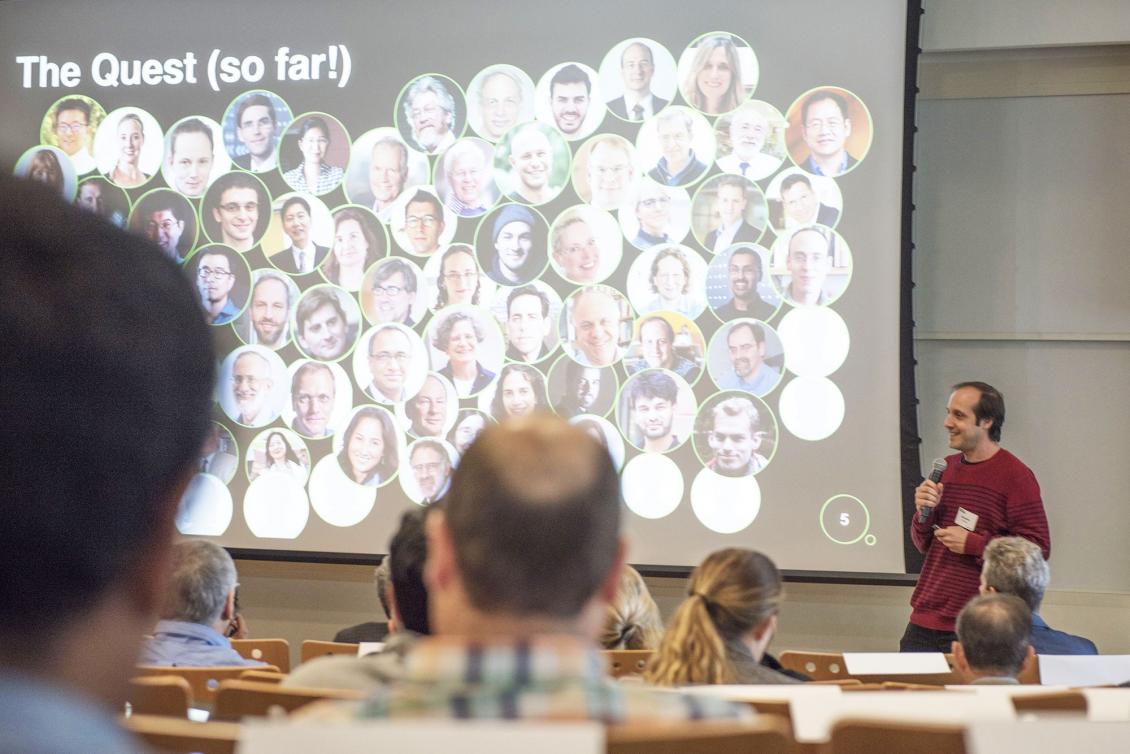
In a packed auditorium on a recent afternoon, leaders of The Quest hosted a workshop to discuss their mission and initial progress, as well as to brainstorm new project ideas with members of the MIT community. The workshop aimed to leverage the collective brainpower of MIT’s network to spark innovative and ambitious ideas that could advance research in human and machine intelligence.
“The goal of The Quest is to do fundamental research in our understanding of what is intelligence, and then use those discoveries to build applications that will solve real problems,” said Antonio Torralba, director of The Quest, as he kicked off the workshop. “One of the key aspects for this enterprise to be successful is that we need involvement from the whole community of MIT.”
Launched last spring, The Quest is a multidisciplinary effort to bolster MIT’s longstanding leadership in studying and engineering intelligence. Torralba, a professor of electrical engineering and computer science who also heads the MIT-IBM Watson AI Lab, and other MIT colleagues discussed The Quest’s mission, which is to address two crucial questions in the field: Can we reverse-engineer intelligence? How can we use our understanding of intelligence to create tools and strategies that make a difference in society?
“These are simultaneously the greatest open questions in the natural sciences and the most important engineering challenges of our time,” said James DiCarlo, director of The Quest Core and head of the Department of Brain and Cognitive Sciences. “These two great challenges are really at an intersection right now.”
Noting that the study of intelligence goes far beyond brain science and computer science, Torralba, DiCarlo, and their collaborators encouraged researchers from across the Institute's five schools to reach out if their work could in any way integrate with the research and education missions of The Quest. Many speakers noted that MIT is particularly well-suited to these collaborative efforts due to the range of expertise found on campus and in the broader Institute community.
Nicholas Roy, director of The Quest Bridge and a professor of aeronautics and astronautics, noted that one important goal of The Quest is to reduce the barrier to entry for tools related to intelligence. Roy described his team’s plans to develop a campus-wide data management platform, bring together hardware and software resources, and provide software engineers to benefit activities in classrooms, research laboratories, and across campus.
“We want to do all of this in the context of a community,” said Roy. “It’s important for us to recognize that as we put together a platform of tools and services for AI for the campus and the broader world, we do it in a way that is ethical, transparent, and unbiased. We need help doing all of these things.”
Leaders within The Quest each shared brief updates on their current work in intelligence and opened the floor to discussion, questions, and idea sharing from workshop attendees.
Leslie Kaelbling, co-scientific director of The Quest Core and a professor of computer science and engineering, described her work to develop physical robots to test and understand fundamental questions in artificial intelligence. She noted that while robots present unique challenges, they allow researchers to integrate multiple aspects of intelligence at once and garner concrete data about how we learn and interact with the world around us.
“Every single time I’ve sat in my office and imagined what that data is going to be like, I’ve been wrong,” said Kaelbling. “I don’t trust myself or really anyone else to imagine what the sensorimotor experience of a robot is going to be like. I think you can do a lot in simulation, but you should eventually touch the world.”
Looking beyond the workshop, Aude Oliva, executive director of The Quest, noted that the team had put out a call for white papers outlining ideas for ambitious projects. She reiterated that individuals from any of the five schools are welcome to build on the momentum of the brainstorming workshop and submit white papers or email them to quest@mit.edu by Nov. 1.
The team also shared that thanks to several generous sponsors — including former Alphabet executive chairman Eric Schmidt and his wife Wendy; the MIT-IBM Watson AI Lab; and the MIT-SenseTime Alliance on Artificial Intelligence — The Quest will fund up to 100 undergraduate students to conduct innovative Quest-associated research through the MIT Undergraduate Research Opportunities Program.
By involving as much of the MIT community as possible, The Quest team said they aim to identify and grow the ideas that are most likely to expand our understanding of intelligence and to enable application of this knowledge to real-world problem solving.
The team plans to host several more workshops and events to engage with interested members of the community throughout the fall and spring.