




How attention helps you remember
by
Anne Trafton, MIT News Office
Image
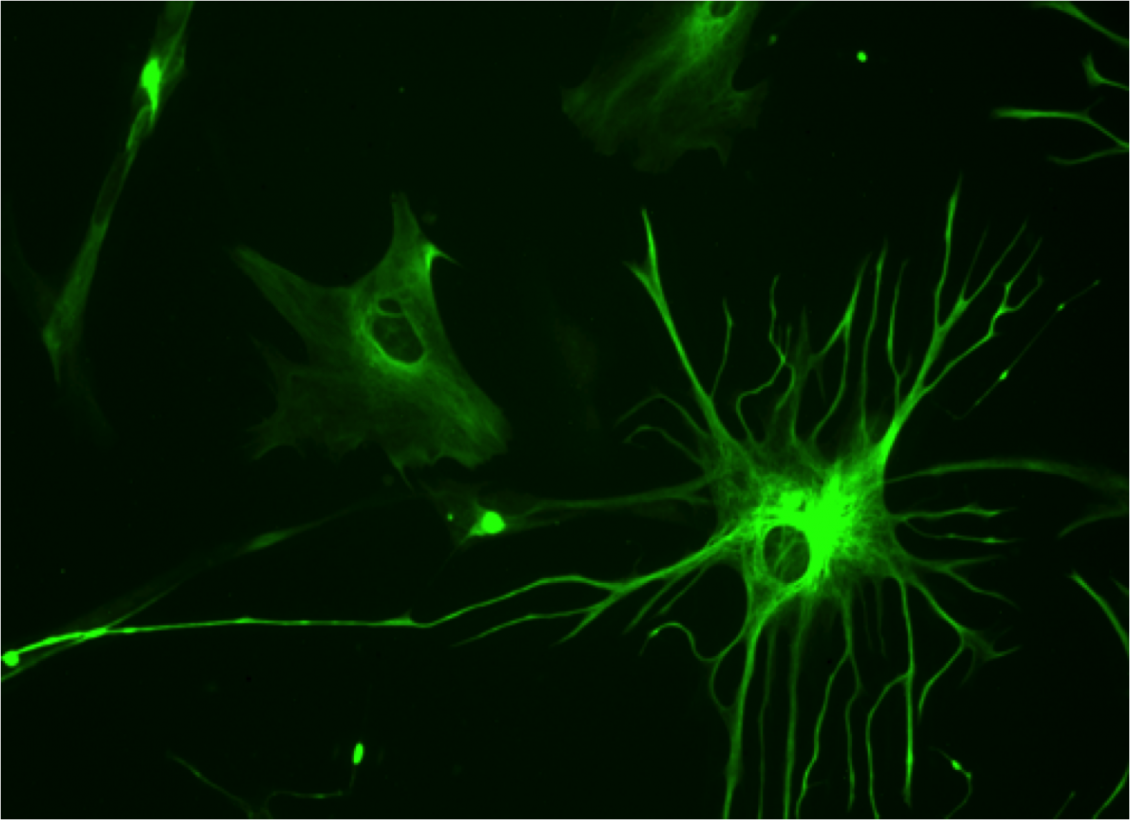
A human astrocyte cell.
A new study from MIT neuroscientists sheds light on a neural circuit that makes us likelier to remember what we’re seeing when our brains are in a more attentive state.
The team of neuroscientists found that this circuit depends on a type of brain cell long thought to play a supporting role, at most, in neural processing. When the brain is attentive, those cells, called astrocytes, relay messages alerting neurons of the visual cortex that they should respond strongly to whatever visual information they are receiving.
The findings, published this week in the online edition of the Proceedings of the National Academy of Sciences, are the latest in a growing body of evidence suggesting that astrocytes are critically important for processing sensory information, says Mriganka Sur, the Paul E. and Lilah Newton Professor of Neuroscience at MIT and senior author of the paper.
Sur’s lab has been studying astrocytes for about five years, as part of a longstanding interest in revealing the functions of different cell types in the cortex. The star-shaped cells were first discovered and named 150 years ago, but since then, “it’s been a mystery what they do,” says Sur, who is a member of MIT’s Picower Institute for Learning and Memory and director of the Simons Center for the Social Brain at MIT.
Lead authors of the paper are graduate student Naiyan Chen and research scientist Hiroki Sugihara. Other authors are research scientist Jitendra Sharma, postdocs Gertrudis Perea and Jeremy Petravicz, and technical assistant Chuong Le.
Attention strengthens response
In this study, the researchers focused on what astrocytes do when the brain is stimulated to pay attention to a specific visual stimulus. When someone is paying close attention to something, the nucleus basalis — a structure located deep within the brain, behind the eyes — floods the brain with a neurotransmitter called acetylcholine. Some of this acetylcholine targets astrocytes in the visual cortex.
To explore how astrocytes react to this stimulation, the researchers measured what happened in the visual cortex as they showed mice several visual patterns composed of parallel lines oriented in different directions. For one of the visual patterns, the researchers also provoked the nucleus basalis to release acetylcholine at the same time. This greatly boosted calcium levels in the astrocytes, indicating high activity.
When the mice were shown the same stimuli a few minutes later, the pattern that had been presented along with acetylcholine stimulation provoked a much stronger response in neurons of the visual cortex than the other patterns.
The researchers then did the same test in genetically engineered mice whose astrocytes were disabled. In those mice, the acetylcholine released by the nucleus basalis did not strengthen neurons’ response to visual stimuli.
“If you are paying attention to something, which causes this release of acetylcholine, that leads to a long-lasting memory of that stimulus. If you remove the astrocytes, that doesn’t happen,” Sur says.
The strengthening effect lasts for tens of minutes, after which the neurons return to their original activity level in response to the selected stimulus.
“More directly than any other study to date, it illustrates the critical role of astrocytes in plasticity,” says Michael Merzenich, a professor emeritus of neuroscience at the University of California at San Francisco, who was not part of the research team. “It’s a crystal-clear demonstration.”
‘Major players in brain disorders’
It is already known that acetylcholine levels drop in the brains of patients with Alzheimer’s disease. In fact, a commonly used treatment that can boost memory in Alzheimer’s patients is a drug that blocks the degradation of acetylcholine. In a follow-up study, the researchers are planning to study how astrocytes are affected in mouse models of Alzheimer’s.
Sur’s lab is also studying the effects of nucleus basalis stimulation on inhibitory neurons. Those effects are thought to be shorter term, lasting seconds or fractions of seconds.
“You cannot understand brain disorders without understanding the basic mechanisms of cortical brain function,” Sur says. “These cell types — astrocytes, inhibitory neurons — are emerging as major players in brain disorders, in unexpected ways.”
The research was funded by the National Institutes of Health and the Simons Foundation.
The team of neuroscientists found that this circuit depends on a type of brain cell long thought to play a supporting role, at most, in neural processing. When the brain is attentive, those cells, called astrocytes, relay messages alerting neurons of the visual cortex that they should respond strongly to whatever visual information they are receiving.
The findings, published this week in the online edition of the Proceedings of the National Academy of Sciences, are the latest in a growing body of evidence suggesting that astrocytes are critically important for processing sensory information, says Mriganka Sur, the Paul E. and Lilah Newton Professor of Neuroscience at MIT and senior author of the paper.
Sur’s lab has been studying astrocytes for about five years, as part of a longstanding interest in revealing the functions of different cell types in the cortex. The star-shaped cells were first discovered and named 150 years ago, but since then, “it’s been a mystery what they do,” says Sur, who is a member of MIT’s Picower Institute for Learning and Memory and director of the Simons Center for the Social Brain at MIT.
Lead authors of the paper are graduate student Naiyan Chen and research scientist Hiroki Sugihara. Other authors are research scientist Jitendra Sharma, postdocs Gertrudis Perea and Jeremy Petravicz, and technical assistant Chuong Le.
Attention strengthens response
In this study, the researchers focused on what astrocytes do when the brain is stimulated to pay attention to a specific visual stimulus. When someone is paying close attention to something, the nucleus basalis — a structure located deep within the brain, behind the eyes — floods the brain with a neurotransmitter called acetylcholine. Some of this acetylcholine targets astrocytes in the visual cortex.
To explore how astrocytes react to this stimulation, the researchers measured what happened in the visual cortex as they showed mice several visual patterns composed of parallel lines oriented in different directions. For one of the visual patterns, the researchers also provoked the nucleus basalis to release acetylcholine at the same time. This greatly boosted calcium levels in the astrocytes, indicating high activity.
When the mice were shown the same stimuli a few minutes later, the pattern that had been presented along with acetylcholine stimulation provoked a much stronger response in neurons of the visual cortex than the other patterns.
The researchers then did the same test in genetically engineered mice whose astrocytes were disabled. In those mice, the acetylcholine released by the nucleus basalis did not strengthen neurons’ response to visual stimuli.
“If you are paying attention to something, which causes this release of acetylcholine, that leads to a long-lasting memory of that stimulus. If you remove the astrocytes, that doesn’t happen,” Sur says.
The strengthening effect lasts for tens of minutes, after which the neurons return to their original activity level in response to the selected stimulus.
“More directly than any other study to date, it illustrates the critical role of astrocytes in plasticity,” says Michael Merzenich, a professor emeritus of neuroscience at the University of California at San Francisco, who was not part of the research team. “It’s a crystal-clear demonstration.”
‘Major players in brain disorders’
It is already known that acetylcholine levels drop in the brains of patients with Alzheimer’s disease. In fact, a commonly used treatment that can boost memory in Alzheimer’s patients is a drug that blocks the degradation of acetylcholine. In a follow-up study, the researchers are planning to study how astrocytes are affected in mouse models of Alzheimer’s.
Sur’s lab is also studying the effects of nucleus basalis stimulation on inhibitory neurons. Those effects are thought to be shorter term, lasting seconds or fractions of seconds.
“You cannot understand brain disorders without understanding the basic mechanisms of cortical brain function,” Sur says. “These cell types — astrocytes, inhibitory neurons — are emerging as major players in brain disorders, in unexpected ways.”
The research was funded by the National Institutes of Health and the Simons Foundation.