




In his own words: BCS grad student Dustin Hayden studies learning and memory
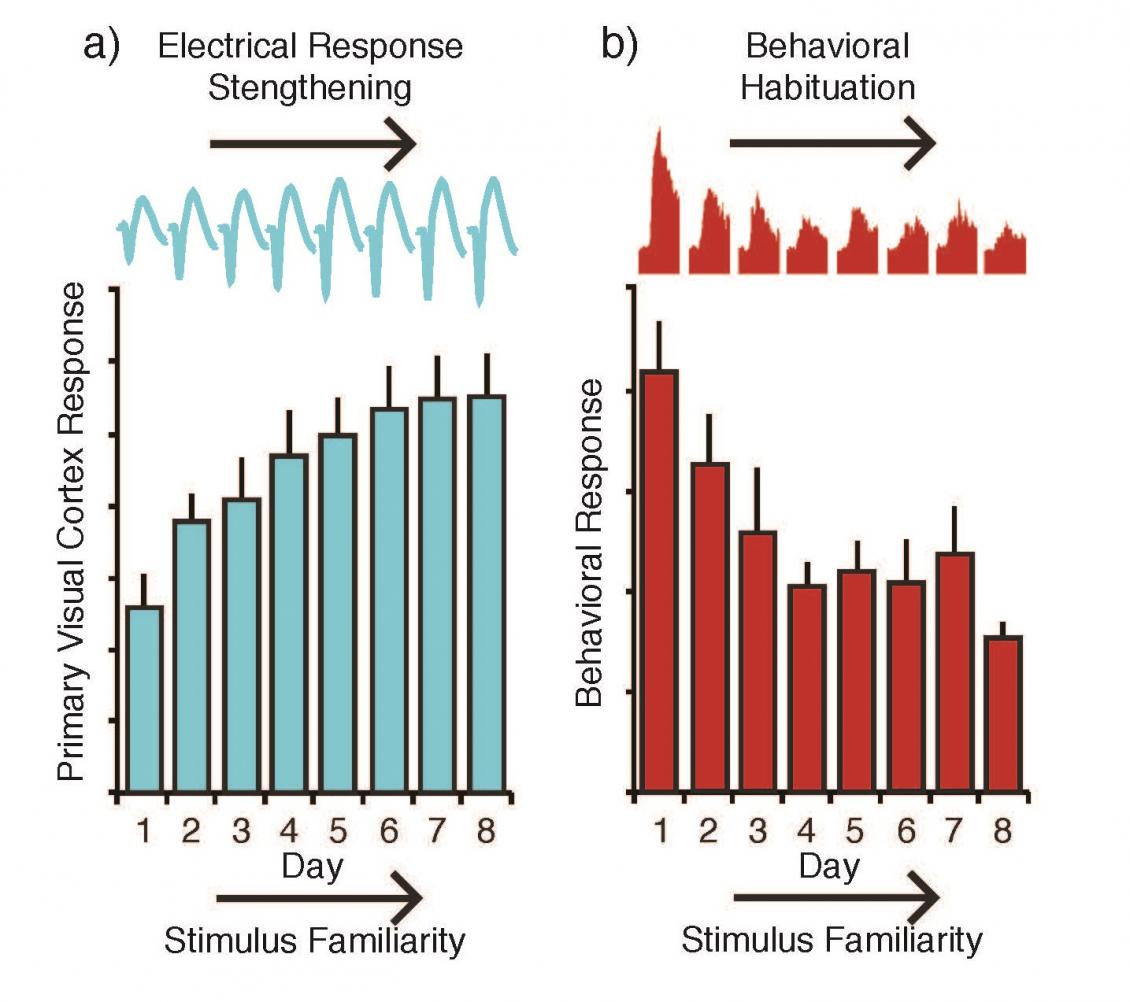
A Simple Learning Experiment in Mice. Mice are implanted with electrodes in primary visual cortex. These mice are shown the same simple visual stimulus over days while measurements of their electrical activity and behavioral response are recorded. a) The electrical activity in primary visual cortex potentiates, or gets larger, as the stimulus repeats over days. b) The behavioral response reduces, or habituates, as the stimulus repeats over days. Figure adapted from Cooke et al., Nature Neuroscience, 2015.
Many years ago, I asked my mother if I could dismantle our VCR. Why? I wanted to see how it worked. Like any good mother, she told me that I was never to take apart the machine. Like any ornery ten-year-old son, I waited until she left for work then took apart the machine. (I did fairly well considering the internet was not yet mainstream and the instruction manual for the VCR not anticipating complete disassembly with a Phillips screwdriver and butter knife.) Unfortunately, my prowess as engineer was as expected for a Fourth Grade student: I was only able to reassemble about 90% of it. Luckily it still mostly worked.
 It came as no surprise when high school and college led me to a career in research. As an undergraduate, I was particularly interested in genetics. Halfway into the second Introduction to Neuroscience class, I became fascinated by the remarkable complexity of the brain. What I had originally thought of as a simple input/output generator turned out to be an incredibly complex array of cell connections, each carrying their own information. Further, these connections and their underlying information are constantly undergoing modulation, manipulation, and even removal. I spent the next hour after that second class slowly eating lunch, wondering how anyone could ever hope to understand the brain.
The answer to that, at least for me, is that the brain is a complex puzzle. There is necessarily a solution, albeit a difficult one, and the first step to any complex solution is to break it down into digestible parts. By solving each part individually, we can gain insight into the complex whole. I do not believe a single person can fully understand the brain, but a global community of researchers, each contributing to an ever-growing body of knowledge, just might.
My small contribution to this endeavor comes in the form of learning and memory. More specifically, I show simple images to mice while recording two things: the electrical activity of the primary visual cortex and the behavioral response of the mouse. By recording electrical activity, I listen to the brain sending, receiving, and processing information. By recording the behavioral response, I gain insight into what said electrical activity is ultimately doing.
When the same simple image (a phase-reversing grating) is shown repeatedly over days, the electrical activity we measure in primary visual cortex potentiates, or gets larger, while the behavioral output reduces, such that the animal no longer responds to the familiar image. This task helps expose parts of the brain’s mechanism for learning and memory, which is informative for future studies concerning learning in general or disorders in which learning deficits occur.
 Despite the relative simplicity of mouse primary visual cortex, the sheer number of molecules, cells, and connections that may be involved in this experimental paradigm makes a simple explanation elusive. My thesis work involves directly manipulating the primary visual cortex and related brain areas to test hypotheses about how the brain changes in response to familiarity.
To accomplish my work, I have taken many wonderful classes either at MIT or via MIT OpenCourseWare, a website where past MIT lectures and exercises are available for free. These classes, taught by fantastic professors, have been instrumental in my development as a scientist and the sophistication with which I can interpret data. Further, the tools available at MIT are remarkably more powerful than the Phillips screwdriver and butter knife I used in my first foray into reverse engineering all those years ago. This combination of sharing both theoretical knowledge and practical application has made MIT an excellent place to tackle difficult research questions.
While the machine may have switched from a video-playing device to an incredible biological think tank, my passion to understand remains the same. In my experience, the MIT community shares that passion.
Hayden is a graduate student in BCS Professor Mark Bear's laboratory. To learn more about their research, visit the lab's website. Photos: Dustin Hayden speaks to supporters at the fall 2016 Champions of the Brain Fellows celebration; Dustin Hayden and Gene Stark at the Champions celebration. Credit: Bryce Vickmark