

Main navigation

  • About BCS
    • Mission
    • History
    • Building 46
      • Building 46 Room Reservations
    • Leadership
    • Employment
    • Contact
      • BCS Spot Awards
      • Building 46 Email and Slack
    • Directory
  • Faculty + Research
    • Faculty
    • Areas of Research
    • Postdoctoral Research
      • Postdoctoral Association and Committees
    • Core Facilities
    • InBrain
      • InBRAIN Collaboration Data Sharing Policy
  • Academics
    • Course 9: Brain and Cognitive Sciences
    • Course 6-9: Computation and Cognition
      • Course 6-9 MEng
    • Brain and Cognitive Sciences PhD
      • How to Apply
      • Program Details
      • Classes
      • Research
      • Student Life
      • For Current Students
    • Molecular and Cellular Neuroscience Program
      • How to Apply to MCN
      • MCN Faculty and Research Areas
      • MCN Curriculum
      • Model Systems
      • MCN Events
      • MCN FAQ
      • MCN Contacts
    • Research Scholars Program
    • Course Offerings
  • News + Events
    • News
    • Events
    • Recordings
    • Newsletter
  • Community + Culture
    • Community + Culture
    • Community Stories
    • Outreach
      • MIT Summer Research Program (MSRP)
      • Conferences, Outreach and Networking Opportunities
    • Post-Baccalaureate Research Scholars Program
    • Get Involved (MIT login required)
    • Resources (MIT login Required)
  • Give to BCS
    • Join the Champions of the Brain Fellows Society
    • Meet Our Donors

Utility Menu

  • Directory
  • Apply to BCS
  • Contact Us

Footer

  • Contact Us
  • Employment
  • Be a Test Subject
  • Login

Footer 2

  • McGovern
  • Picower

Utility Menu

  • Directory
  • Apply to BCS
  • Contact Us
Brain and Cognitive Sciences
Menu
MIT

Main navigation

  • About BCS
    • Mission
    • History
    • Building 46
    • Leadership
    • Employment
    • Contact
    • Directory
  • Faculty + Research
    • Faculty
    • Areas of Research
    • Postdoctoral Research
    • Core Facilities
    • InBrain
  • Academics
    • Course 9: Brain and Cognitive Sciences
    • Course 6-9: Computation and Cognition
    • Brain and Cognitive Sciences PhD
    • Molecular and Cellular Neuroscience Program
    • Research Scholars Program
    • Course Offerings
  • News + Events
    • News
    • Events
    • Recordings
    • Newsletter
  • Community + Culture
    • Community + Culture
    • Community Stories
    • Outreach
    • Post-Baccalaureate Research Scholars Program
    • Get Involved (MIT login required)
    • Resources (MIT login Required)
  • Give to BCS
    • Join the Champions of the Brain Fellows Society
    • Meet Our Donors

News

News Menu

  • News
  • Events
  • Newsletters

Breadcrumb

  1. Home
  2. News
  3. Five with MIT ties elected to the National Academy of Medicine for 2022
October 18, 2022

Five with MIT ties elected to the National Academy of Medicine for 2022

by
Danielle Randall Doughty | Department of Chemistry
Image
Five with MIT ties elected to the National Academy of Medicine for 2022
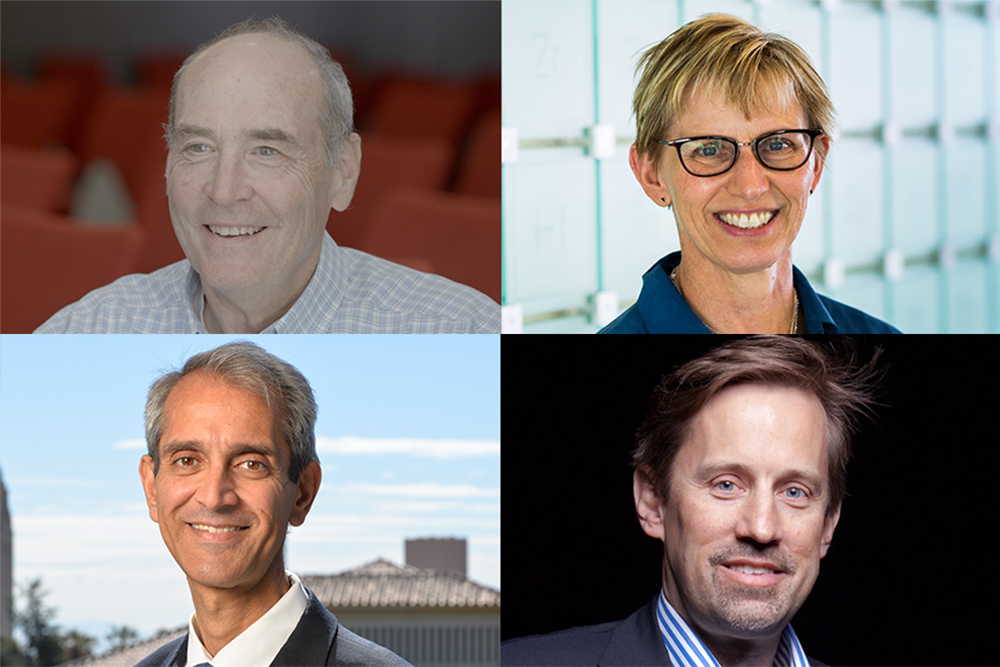
New members of the National Academy of Medicine with MIT ties (clockwise from top left): Mark Bear, Laura Kiessling, David Tuveson, and Krishna Shenoy. Not pictured: Martin Burke

On October 17, the National Academy of Medicine announced the election of 100 new members to join their esteemed ranks. MIT faculty members Laura L. Kiessling ’83 and Mark Bear were among the new members, along with MIT alumni Krishna Shenoy SM '92, PhD '95 and David Tuveson ’87. Martin Burke, a former student in the Harvard-MIT Program in Health Sciences and Technology, was also elected.

Election to the National Academy of Medicine is considered one of the highest honors in the fields of health and medicine, and recognizes individuals who have demonstrated outstanding professional achievement and commitment to service, the Academy noted in announcing the election of its new members.

Bear, Professor of Neuroscience, was elected “For his discovery of fundamental mechanisms by which sensory experience and deprivation modify synapses by increasing or decreasing their strength during the development of the brain, and how these mechanisms contribute to, and can be marshalled to treat, developmental brain disorders.”

Kiessling, the Novartis Professor of Chemistry, was recognized “For chemistry-enabled fundamental discoveries regarding protein-glycan interactions pertinent to immunity and inflammation, host-microbe interactions, and human development, and leveraging these findings for new therapeutic strategies.”

Shenoy, a Howard Hughes Medical Institute Investigator and the Hong Seh and Vivian W M Lim Professor of Engineering at Stanford, earned his Master’s and PhD from the MIT Department of Electrical Engineering and Computer Science. He was chosen for election due to his “contributions both to basic neuroscience and to translational and clinical research. His work has shown how networks of motor cortical neurons operate as dynamical systems, and he has developed new technologies to provide new means of restoring movement and communication to people with paralysis.”

Tuveson, the Roy J. Zuckerberg Professor and director of the Cold Spring Harbor Laboratory Cancer Center, is an alumnus of the MIT Department of Chemistry. The NAM recognized him “for his transformative leadership in pancreatic cancer biology. His work has led to the development of powerful pancreatic cancer models, which has been fundamental to preclinical studies of understanding targeted therapy and treatment of pancreatic cancer. He most recently has been a leader in organoid-based cancer models.”

Burke, the Ving Lee Professor for Chemical Innovation at the University of Illinois at Urbana-Champaign’s Carle Illinois College of Medicine, was elected “for creating a modular molecular synthesis platform with broad applications in health science and technology, including his pioneering research on molecular prosthetics for cystic fibrosis, and for helping mitigate the spread of COVID-19 with saliva-based testing.”

“This extraordinary class of new members is comprised of exceptional scholars and leaders who have been at the forefront of responding to serious public health challenges, combatting social inequities, and achieving innovative discoveries,” says National Academy of Medicine President Victor J. Dzau. “Their expertise will be vital to informing the future of health and medicine for the benefit of us all.  I am truly honored to welcome these esteemed individuals to the National Academy of Medicine.”

Read the Original Article
Don't miss our next newsletter!
Sign Up

Footer menu

  • Contact Us
  • Employment
  • Be a Test Subject
  • Login

Footer 2

  • McGovern
  • Picower
Brain and Cognitive Sciences

MIT Department of Brain and Cognitive Sciences

Massachusetts Institute of Technology

77 Massachusetts Avenue, Room 46-2005

Cambridge, MA 02139-4307 | (617) 253-5748

For Emergencies | Accessibility

Massachusetts Institute of Technology