




Five MIT School of Science professors receive tenure for 2021
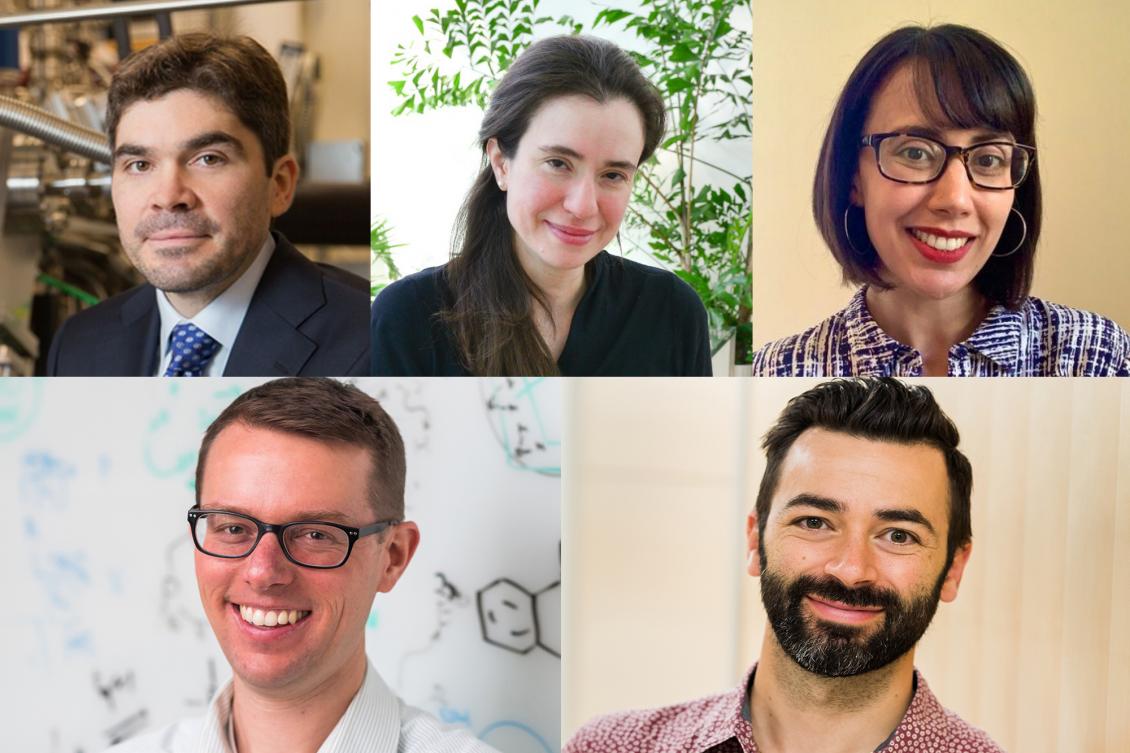
MIT has granted tenure to five faculty members in the MIT School of Science in the departments of Brain and Cognitive Sciences, Chemistry, and Physics.
Physicist Joseph Checkelsky investigates exotic electronic states of matter through the synthesis, measurement, and control of solid-state materials. His research aims to uncover new physical phenomena that expand the boundaries of understanding of quantum mechanical condensed matter systems and open doorways to new technologies by realizing emergent electronic and magnetic functionalities. Checkelsky joined the Department of Physics in 2014 after a postdoc appointment at Japan’s Institute for Physical and Chemical Research and a lectureship at the University of Tokyo. He earned a bachelor’s degree in physics from Harvey Mudd College in 2004; and in 2010, he received a doctoral degree in physics from Princeton University.
A molecular neurobiologist and geneticist, Myriam Heiman studies the selective vulnerability and pathophysiology seen in neurodegenerative diseases of the brain’s basal ganglia, including Huntington’s disease and Parkinson’s disease. Using a revolutionary transcriptomic technique called translating ribosome affinity purification, she aims to understand the early molecular changes that eventually lead to cell death in these diseases. Heiman joined the Department of Brain and Cognitive Sciences, the Picower Institute for Learning and Memory, and the Broad Institute of Harvard and MIT in 2011 after completing her postdoctoral training at The Rockefeller University. She holds a PhD from Johns Hopkins University and a BA from Princeton University.
Particle physicist Kerstin Perez is interested in using cosmic particles to look beyond Standard Model physics, in particular evidence of dark matter interactions. Her work focuses on opening sensitivity to unexplored cosmic signatures with impact at the intersection of particle physics, astrophysics, and advanced instrumental techniques. Perez joined the Department of Physics in 2016, after a National Science Foundation astronomy and astrophysics postdoctoral fellowship at Columbia University and a faculty appointment at Haverford College. She earned her BA in physics from Columbia University in 2005, and her PhD from Caltech in 2011.
Alexander Radosevich works at the interface of inorganic and organic chemistry to design new chemical reactions. In particular, his interests concern the invention of compositionally new classes of molecular catalysts based on inexpensive and Earth-abundant elements of the p-block. This research explores the connection between molecular structure and reactivity in an effort to discover new efficient and sustainable approaches to chemical synthesis. Radosevich returned to the MIT Department of Chemistry, where he also held a postdoctoral appointment in 2016, after serving on the faculty at The Pennsylvania State University. He received a BS from the University of Notre Dame in 2002, and a PhD from University of California at Berkeley in 2007.
Alex K. Shalek creates and implements new experimental and computational approaches to identify the cellular and molecular features that inform tissue-level function and dysfunction across the spectrum of human health and disease. This encompasses both the development of broadly enabling technologies, such as Seq-Well, as well as their application to characterize, model, and rationally control complex multicellular systems. In addition to sharing this toolbox to empower mechanistic scientific inquiry across the global research community, Shalek is applying it to uncover principles that inform a wide range of problems in immunology, infectious diseases, and cancer. Shalek joined the Department of Chemistry and the Institute of Medical Engineering and Science in 2014 after postdoctoral training at Harvard University and the Broad Institute. He received his BA in chemical physics at Columbia University in 2004, followed by a PhD from Harvard University in 2011.