




Five MIT faculty elected 2021 AAAS Fellows
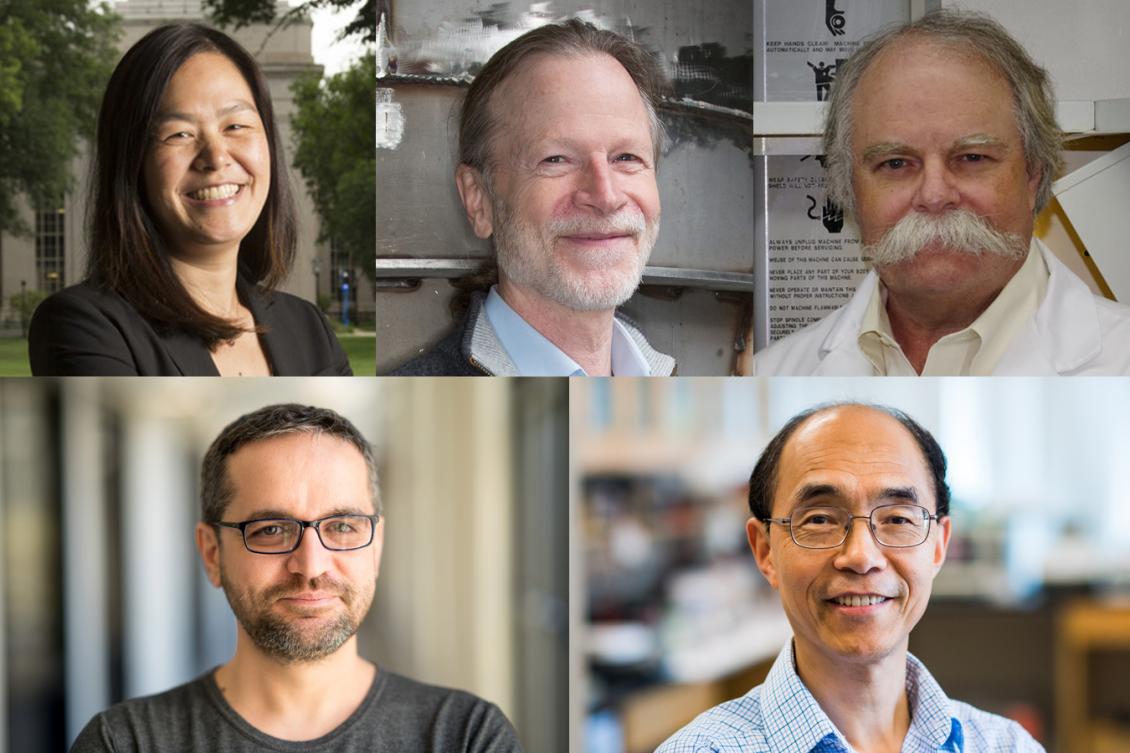
Five MIT faculty members have been elected as fellows of the American Association for the Advancement of Science (AAAS).
The 2021 class of AAAS Fellows includes 564 scientists, engineers, and innovators spanning 24 scientific disciplines who are being recognized for their scientifically and socially distinguished achievements.
Mircea Dincă is the W. M. Keck Professor of Energy in the Department of Chemistry. His group’s research focuses on addressing challenges related to the storage and consumption of energy, and global environmental concerns. Central to these efforts are the synthesis of novel organic-inorganic hybrid materials and the manipulation of their electrochemical and photophysical properties, with a current emphasis on porous materials and extended one-dimensional van der Waals materials.
Guoping Feng is the James W. and Patricia T. Poitras Professor of Neuroscience in the Department of Brain and Cognitive Sciences, associate director of MIT’s McGovern Institute for Brain Research, director of Model Systems and Neurobiology at the Stanley Center for Psychiatric Research, and an institute member of the Broad Institute of MIT and Harvard. His research is devoted to understanding the development and function of synapses in the brain and how synaptic dysfunction may contribute to neurodevelopmental and psychiatric disorders. By understanding the molecular, cellular, and circuitry mechanisms of these disorders, Feng hopes his work will eventually lead to the development of new and effective treatments for the millions of people suffering from these devastating diseases.
David Shoemaker is a senior research scientist with the MIT Kavli Institute for Astrophysics and Space Research. His work is focused on gravitational-wave observation and includes developing technologies for the detectors (LIGO, LISA), developing proposals for new instruments (Cosmic Explorer), managing the teams to build them and the consortia which exploit the data (LIGO Scientific Collaboration, LISA Consortium), and supporting the overall growth of the field (Gravitational-Wave International Committee).
Ian Hunter is the Hatsopoulos Professor of Mechanical Engineering and runs the Bioinstrumentation Lab at MIT. His main areas of research are instrumentation, microrobotics, medical devices, and biomimetic materials. Over the years he and his students have developed many instruments and devices including: confocal laser microscopes, scanning tunneling electron microscopes, miniature mass spectrometers, new forms of Raman spectroscopy, needle-free drug delivery technologies, nano- and micro-robots, microsurgical robots, robotic endoscopes, high-performance Lorentz force motors, and microarray technologies for massively parallel chemical and biological assays.
Evelyn N. Wang is the Ford Professor of Engineering and head of the Department of Mechanical Engineering. Her research program combines fundamental studies of micro/nanoscale heat and mass transport processes with the development of novel engineered structures to create innovative solutions in thermal management, energy, and water harvesting systems. Her work in thermophotovoltaics was named to Technology Review’s lists of Biggest Clean Energy Advances, in 2016, and Ten Breakthrough Technologies, in 2017, and to the Department of Energy Frontiers Research Center’s Ten of Ten awards. Her work extracting water from air has won her the title of 2017 Foreign Policy's Global ReThinker and the 2018 Eighth Prince Sultan bin Abdulaziz International Prize for Water.