




Ed Boyden and Feng Zhang named Howard Hughes Medical Institute Investigators
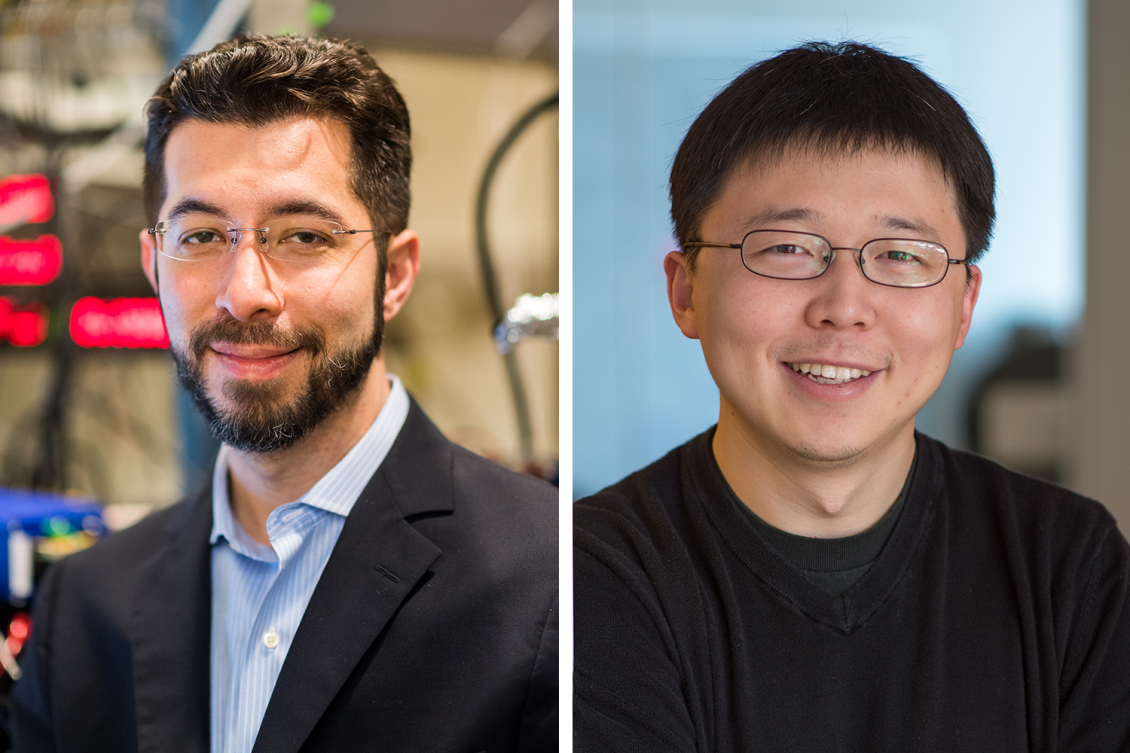
Two members of the MIT faculty were named Howard Hughes Medical Institute (HHMI) investigators today. Ed Boyden and Feng Zhang join a community of 300 HHMI scientists who are “transforming biology and medicine, one discovery at a time.” Both researchers have been instrumental in recognizing, developing, and sharing robust tools with broad utility that have revolutionized the life sciences.
“We are thrilled that Ed and Feng are being recognized in this way” says Robert Desimone, director of the McGovern Institute for Brain Research at MIT. “Being named to the investigator program recognizes their previous achievements and allows them to follow the innovative path that is a trait of their research.”
HHMI selects new Investigators to join its flagship program through periodic competitions. In choosing researchers to join its investigator program, HHMI specifically aims to select ‘people, not projects’ and identifies trail blazers in the biomedical sciences. The organization provides support for an unusual length of time, seven years with a renewal process at the end of that period, thus giving selected scientists the time and freedom to tackle difficult and important biological questions. HHMI-affiliated scientists continue to work at their home institution. The HHMI Investigator program currently funds 300 scientists at 60 research institutions across the United States.
Ed Boyden, the Y. Eva Tan Professor in Neurotechnology at MIT, has pioneered a number of technologies that allow visualization and manipulation of complex biological systems. Boyden worked, along with Karl Deisseroth and Feng Zhang, on optogenetics, a system that leverages microbial opsins to manipulate neuronal activity using light. This technology has transformed our ability to examine neuronal function in vivo. Boyden’s work initiated optogenetics, then extended it into a multicolor, high-speed, and noninvasive toolbox. Subsequent technological advances developed by Boyden and his team include expansion microscopy, an imaging strategy that overcomes the limits of light microscopy by expanding biological specimens in a controlled fashion. Boyden's team also recently developed a directed evolution system that is capable of robotically screening hundreds of thousands of mutated proteins for specific properties within hours. He and his team recently used the system to develop a high-performance fluorescent voltage indicator.
“I am honored and excited to become an HHMI investigator,” says Boyden, who is also a member of MIT’s McGovern Institute for Brain Research and Koch Institute for Integrative Cancer Research and an associate professor in the Program in Media Arts and Sciences at the MIT Media Lab; the MIT Department of Brain and Cognitive Sciences; and the MIT Department of Biological Engineering. “This will give my group the ability to open up completely new areas of science, in a way that would not be possible with traditional funding.”
Feng Zhang is a molecular biologist focused on building new tools for probing the human brain. As a graduate student, Zhang was part of the team that developed optogenetics. Zhang went on to develop other innovative tools. These achievements include the landmark deployment of the microbial CRISPR-Cas9 system for genome engineering in eukaryotic cells. The ease and specificity of the system has led to its widespread use. Zhang has continued to mine bacterial CRISPR systems for additional enzymes with useful properties, leading to the discovery of Cas13, which targets RNA, rather than DNA. By leveraging the unique properties of Cas13, Zhang and his team created a precise RNA editing tool, which may potentially be a safer way to treat genetic diseases because the genome does not need to be cut, as well as a molecular detection system, termed SHERLOCK, which can sense trace amounts of genetic material, such as viruses.
“It is so exciting to join this exceptional scientific community,” says Zhang, “and be given this opportunity to pursue our research into engineering natural systems.”
Zhang is the James and Patricia Poitras Professor of Neuroscience at MIT, an associate professor in the MIT departments of Brain and Cognitive Sciences and Biological Engineering, an investigator at the McGovern Institute for Brain Research, and a core member of the Broad Institute of MIT and Harvard.
The MIT Media Lab, Broad Institute of MIT and Harvard, and MIT departments of Brain and Cognitive Sciences and Biological Engineering contributed to this article.