




Boyden to share prestigious brain prize
by
McGovern Institute for Brain Research
Image
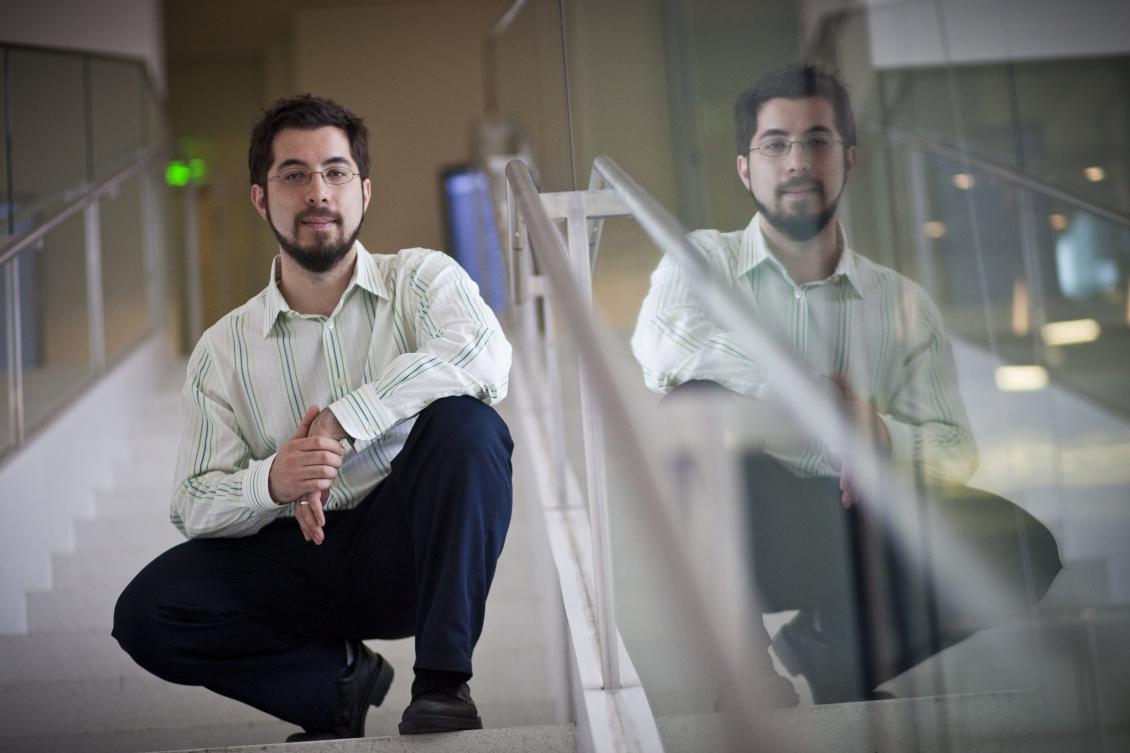
Ed Boyden, the Benesse Career Development Professor in the MIT Media Lab
Ed Boyden, a faculty member in the MIT Media Lab and the McGovern Institute for Brain Research, was today named a recipient of the 2013 Grete Lundbeck European Brain Research Prize. The 1 million Euro prize is awarded for the development of optogenetics, a technology that makes it possible to control brain activity using light.
The Brain Prize is awarded annually by the Denmark-based Lundbeck Foundation for outstanding contributions to European neuroscience. Boyden is recognized for work done in collaboration with Karl Deisseroth at Stanford University, which builds on earlier discoveries by four European researchers: Ernst Bamberg, Georg Nagel and Peter Hegemann in Germany, and Gero Miesenböck, now in Oxford, U.K. The prize will be shared equally between all six researchers.
The idea of using light to control brain activity was suggested by Francis Crick in 1999, and Miesenbock performed a proof of concept demonstration in 2002, showing that light-sensitive proteins obtained from the eyes of fruit-flies could be used to activate mammalian neurons. A further breakthrough was enabled by the discovery of channelrhodopsin-2 (ChR2), a light-activated ion channel from a common pond algal species that had been characterized by Hegemann in Martinsried and by Nagel and Bamberg in Frankfurt.
The application of ChR2 to neuroscience was pioneered by Boyden and Deisseroth at Stanford University, where Deisseroth is now a faculty member. In a collaboration that began when Boyden was a graduate student and Deisseroth a postdoctoral fellow, they obtained the ChR2 gene from Nagel and Bamberg, expressed it in cultured neurons, and pulsed the dish with blue light to see whether it could trigger neural activity. The first experiment was performed in August 2004, and it worked first time; as Boyden recounted in a recent historical article, “serendipity had struck — the molecule was good enough in its wild-type form to be used in neurons right away.”
They reported this result in 2005, in a landmark paper in Nature Neuroscience that has now been cited more than 600 times. Their method, later dubbed “optogenetics,” is now used by hundreds of labs worldwide and is also being explored for a wide range of potential therapeutic applications. In announcing the Brain Prize, the chairman of the selection committee, Professor Colin Blakemore, described optogenetics as “arguably the most important technical advance in neuroscience in the past 40 years.”
Boyden joined the MIT faculty in 2006, where he is now the Benesse Career Development Professor in the Media Lab, with joint appointments at the McGovern Institute for Brain Research and in the Departments of Biological Engineering and Brain and Cognitive Sciences. His contributions have been recognized by numerous awards and honors, including the inaugural AF Harvey Prize and the 2011 Perl/UNC prize (shared with Karl Deisseroth and with Feng Zhang, also at MIT). He continues to develop novel optogenetic tools, along with many other technologies for understanding and manipulating neural circuits within the living brain.
Boyden's work was supported by the Fannie and John Hertz Foundation, the Helen Hay Whitney Foundation, the McKnight Foundation, Jerry and Marge Burnett, DARPA and the Department of Defense, Google, Harvard/MIT Joint Grants Program in Basic Neuroscience, Human Frontiers Science Program, IET A. F. Harvey Prize, MIT McGovern Institute and MIT Media Lab, NARSAD, New York Stem Cell Foundation-Robertson Investigator Award, NIH, NSF, Paul Allen Distinguished Investigator in Neuroscience Award, Shelly Razin, SkTech, Alfred P. Sloan Foundation, the Society for Neuroscience Research Award for Innovation in Neuroscience (RAIN), and the Wallace H. Coulter Foundation.
The Brain Prize is awarded annually by the Denmark-based Lundbeck Foundation for outstanding contributions to European neuroscience. Boyden is recognized for work done in collaboration with Karl Deisseroth at Stanford University, which builds on earlier discoveries by four European researchers: Ernst Bamberg, Georg Nagel and Peter Hegemann in Germany, and Gero Miesenböck, now in Oxford, U.K. The prize will be shared equally between all six researchers.
The idea of using light to control brain activity was suggested by Francis Crick in 1999, and Miesenbock performed a proof of concept demonstration in 2002, showing that light-sensitive proteins obtained from the eyes of fruit-flies could be used to activate mammalian neurons. A further breakthrough was enabled by the discovery of channelrhodopsin-2 (ChR2), a light-activated ion channel from a common pond algal species that had been characterized by Hegemann in Martinsried and by Nagel and Bamberg in Frankfurt.
The application of ChR2 to neuroscience was pioneered by Boyden and Deisseroth at Stanford University, where Deisseroth is now a faculty member. In a collaboration that began when Boyden was a graduate student and Deisseroth a postdoctoral fellow, they obtained the ChR2 gene from Nagel and Bamberg, expressed it in cultured neurons, and pulsed the dish with blue light to see whether it could trigger neural activity. The first experiment was performed in August 2004, and it worked first time; as Boyden recounted in a recent historical article, “serendipity had struck — the molecule was good enough in its wild-type form to be used in neurons right away.”
They reported this result in 2005, in a landmark paper in Nature Neuroscience that has now been cited more than 600 times. Their method, later dubbed “optogenetics,” is now used by hundreds of labs worldwide and is also being explored for a wide range of potential therapeutic applications. In announcing the Brain Prize, the chairman of the selection committee, Professor Colin Blakemore, described optogenetics as “arguably the most important technical advance in neuroscience in the past 40 years.”
Boyden joined the MIT faculty in 2006, where he is now the Benesse Career Development Professor in the Media Lab, with joint appointments at the McGovern Institute for Brain Research and in the Departments of Biological Engineering and Brain and Cognitive Sciences. His contributions have been recognized by numerous awards and honors, including the inaugural AF Harvey Prize and the 2011 Perl/UNC prize (shared with Karl Deisseroth and with Feng Zhang, also at MIT). He continues to develop novel optogenetic tools, along with many other technologies for understanding and manipulating neural circuits within the living brain.
Boyden's work was supported by the Fannie and John Hertz Foundation, the Helen Hay Whitney Foundation, the McKnight Foundation, Jerry and Marge Burnett, DARPA and the Department of Defense, Google, Harvard/MIT Joint Grants Program in Basic Neuroscience, Human Frontiers Science Program, IET A. F. Harvey Prize, MIT McGovern Institute and MIT Media Lab, NARSAD, New York Stem Cell Foundation-Robertson Investigator Award, NIH, NSF, Paul Allen Distinguished Investigator in Neuroscience Award, Shelly Razin, SkTech, Alfred P. Sloan Foundation, the Society for Neuroscience Research Award for Innovation in Neuroscience (RAIN), and the Wallace H. Coulter Foundation.