




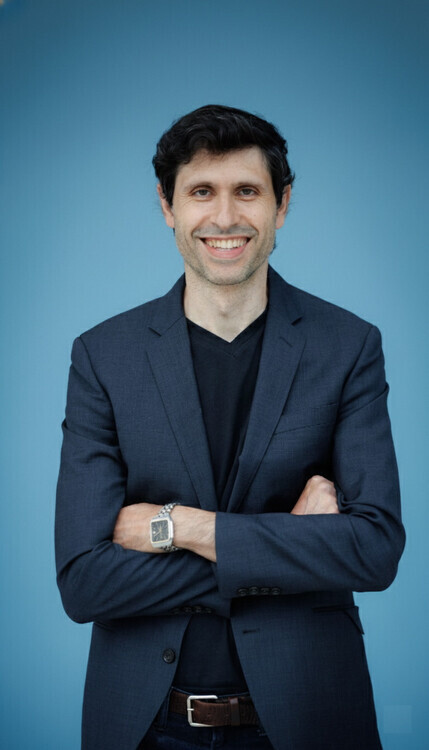
Colloquium on the Brain and Cognition with Elias Issa
Description
Time: 4:00pm
Location: 46-3002, Singleton Auditorium (Third floor of MIT Building 46)
Talk Title: Contrastive self-supervised learning in high-level visual cortex
Abstract:
Self-supervised learning theory (SSL) proposes learning powerful representations directly from the visual input without external supervision, only using internally generated supervisory signals. However, we lack direct neural evidence for SSL induced visual plasticity and on the nature of internal supervision in the brain. Here, we show that primate high-level visual cortex can switch the direction of learning in individual neurons, matching the two opposing operations invoked in contrastive SSL. Inputs were pushed together in neural responses when closely presented during fixation viewing (invariance building), while inputs were pushed apart when saccaded between during free viewing (discrimination building). Thus, the biological implementation of the requisite internal signal relies on the distinction between periods of eye movement versus fixation to self-supervise visual representation learning across natural scenes.
Speaker Bio:
I am a systems and computational neuroscientist studying the neural algorithms underlying high-level vision, visual learning, and visual cognition. We have focussed on how the geometry of faces, objects, and the larger scene is learned and coded by populations of neurons in the marmoset temporal lobe. We implement observed neural phenomena into computational models of vision and utilize behavioral paradigms to link neural phenomena to visual behavior. Scientists in the lab work at the intersection of neuroscience and machine learning in their research projects.